Respacio Plugin for WP RH Real Homes Theme for real estate
We’re working on a new Plugin to synchronise listings between the Respacio CRM and RH (Real Homes) Real Estate WordPress Theme for WordPress.
As soon as the Plugin is published, you can check back on this page for more information on how to install and set up the plugin. You can find out more about the RH Real Estate plugin here.
Have you ever dreamt of automatically replying to enquiries from property portals like Rightmove, Zillow, Idealista, Realtor.com instantly via Whatsapp? Imagine capturing piping-hot leads before your competitors even get a whiff! Well, this dream can become reality, and Respacio can help you achieve it.
This article will explore the power of Whatsapp for lead generation in the real estate industry and how Respacio’s unique automation features can put you miles ahead. We’ll also delve into crafting the perfect message to skyrocket your conversion rates.
Why Whatsapp? It’s All About Timing and Engagement
The statistics speak for themselves: Whatsapp boasts a near-perfect 98% open rate compared to a measly 20% for emails. Conversion rates for email marketing also lag far behind, typically hovering between 2-5%. Whatsapp, on the other hand, is the undisputed champion of modern communication, making it the ideal platform to connect with potential buyers.
But it’s not just about the platform; it’s about timing. Imagine a lead inquiring about a property on a Saturday night. By the time you respond on Monday morning, their enthusiasm has likely fizzled out. Respond immediately, when the property is fresh in their mind, and you’ll dramatically increase your chances of securing an appointment.
The Power of Automation: Respacio to the Rescue
Here’s where Respacio shines. It seamlessly integrates with your email inbox, constantly on the lookout for those precious enquiry emails from property portals. The moment Respacio detects an email, it springs into action, adding the lead as a new contact and firing off a Whatsapp response – all happening automatically, 24/7. So, while you’re enjoying your Saturday night off, Respacio is diligently working on securing your next client.
Crafting the Perfect Whatsapp Message
Now, let’s talk about crafting the perfect Whatsapp message to maximize your conversion rates. Here are some key ingredients:
Personalization: Start with a friendly greeting using the lead’s name (e.g., "Hi John"). A personal touch goes a long way in building rapport.
Visual Appeal: Include a photo of the property to instantly grab the lead’s attention and visually connect it to their enquiry.
Re-introduce the Property: Briefly mention the property type, location, and price to jog their memory and ensure they’re on the same page.
Drive Traffic to Your Website: Include a short link to the property listing on your website. This steers them away from competitor listings and gives you more control over the information they see.
Call to Action: Don’t just say you’ll be in touch later. Motivate them to take action by offering to answer questions or schedule a viewing.
Calendar Link: Provide a link to your scheduling page to make booking a call or video meeting effortless. This empowers them to take the next step on their own terms.
By combining these elements and leveraging Respacio’s automation, you’ll be sending highly engaging messages at the perfect time, through their preferred communication channel. This translates to a significant increase in qualified leads and a dramatic reduction in wasted time chasing elusive prospects.
Stop Wasting Time, Start Converting Leads
Imagine a Monday morning where your calendar is brimming with appointments for qualified leads, ready to view properties and discuss their needs. This is the reality Respacio can help you create. Stop wasting hours on tedious tasks and chasing leads. Focus on what matters most – closing deals!
Ready to unleash the power of Whatsapp for your real estate business? Scan the QR code provided in the video or visit our website (link in the description) to get started.
For more real estate marketing tips and insights on how to leverage Whatsapp as a lead generation powerhouse, subscribe to our Youtube channel! We’re here to answer any questions you may have, so leave a comment below and we’ll get back to you personally.
Don’t let your competitors steal a march on you. Embrace the power of instant Whatsapp communication and watch your lead conversion rates soar with Respacio!
Google Search Generative Results (SGE) is changing real estate SEO in 2024 in two fundamental ways. The first is that the SGE result, generated by AI, interprets your search query and provides a good enough answer which results in a zero click search. Secondly the SGE section takes up a lot of space and shows above the traditional search results list. Far fewer users scroll down to the see the list and links shown at the top in the SGE section panels take most of the clicks.
In this article, we show how SGE sections vary with the results for 3 popular real estate searches and identify the SEO target positions that real estate websites need to rank in 2024.
SGE will change the search results page forever. December 2023 saw the end of SGE’s testing phase in Google Search Labs, and the technology is ready to go live in early 2024. Read this to start your preparation.
What is Google SGE and Why is it Important for Real Estate Agents?
Google SGE is so important for Real Estate Agents because the vast majority of property buyers and sellers search the internet to find both property listings and agents. Agent websites compete fiercely to be at the top of the search results list, but now they need to shift their focus to SGE optimisation in order to get enquiries and leads.
SGE is the name used by Google to describe the new search results user experience. In a practical sense, this is a large new section that appears above the traditional results we are used to. AI will aim to answer the user query and it will provide links to websites from where it has sourced the information. The organic list of results we are used to is pushed down the page, below the user’s viewport.
For Real Estate Agents whose websites currently rank at the top of Google’s organic search results, there is a high risk of losing a large proportion of your visitors. For those agents with websites not ranking right at the top of organic search results, there are new opportunities to gain traffic.
At the moment, the top 3 organic results on a Google Search page receive more than two-thirds of the clicks . A snippet, which is a panel above the #1 organic search result, is the search result with the highest overall CTR.
In 2024 Google’s SGE will be adding many more panels to the top of the search results page, before you scroll to the list of websites.
These additional panels, built by AI, are going to tempt the user with dozens of alternatives links. These alternative links are opportunities for your site to gain more enquiries and conversions.
And the old winners that once ranked at the top of the list will find that they are now a long scroll down with dozens of links above them.
What’s behind Google SGE?
Providing the best result to a search query is the foundation of Google’s business model and this is the next evolutionary step in that journey. SGE is Google’s new front end , a new design of search results with panels of information and links related to the answer to your query.
The content of these SGE panels is generated by artificial intelligence and Google is integrating Gemini, its powerful multimodal language model. Multi modal means that unlike chat GPT, Gemini is not limited to text. Gemini also understands images, audio and video.
According to Google’s own blog their aim is "AI that feels less like a smart piece of software and more like something useful and intuitive — an expert helper or assistant."
SGE is likely to evolve rapidly over the next months and as we see it applied to an increasing number of queries, we may also see new panels introduced and the arrangement and presentation of the panels on the page change.
We are entering a period of rapid evolution in search triggered by AI. Real Estate Websites will also need to evolve and adapt if they are to gain traffic from the changes.
How does Google SGE affect Real Estate Website Traffic?
Google SGE will have a dramatic negative impact on the number of visitors to many real estate web pages for two reasons:
Zero Click Searches
SGE is more likely to answer a user query without them clicking on any link at all. At the top of Google’s new Search Engine Results Page (SERP) is an AI generated information panel that answers the user’s question. A 2022 study shows that 57% of mobile searches and a quarter of desktop searches are zero click searches. This number will only increase with SGE.
SGE page layout
SGE changes the layout of the search results page by providing many more links in its AI generated panels to click before getting to the organic search results. This changes how we need to optimise our content. Ranking #1 in the organic list of results does not guarantee a position in SGE.
Real Estate web pages that previously enjoyed high high rankings and traffic are likely to lose out if they are not optimised for SGE. A study by Search Engine Land shows the expected traffic loss to be 18-64%, however the same study also shows traffic rising when sites are optimised for SGE. Currently these are models and based on some fundamental assumptions but there is unanimous agreement in all studies that websites will see a dramatic traffic drop if they do not adjust their strategies to the new AI search results.
It is worth noting that Google does not provide an SGE section above every search at the moment, quite often Google reports that there is currently no SGE result. However as SGE rolls out, we would expect it to be almost omnipresent.
Example SGE Results for Real Estate Searches
The SGE section is positioned above the normal search results you are familiar with in Google.
Results that previously showed a map and businesses on the top, for example when you search a term like "real estate agent Ottawa", still show that map but it is pushed below the SGE section. This means that there’s a long way to scroll before you reach the organic list of results, so the #1 result is going to get a fraction of the traffic it once did.
Searching for property for sale with SGE
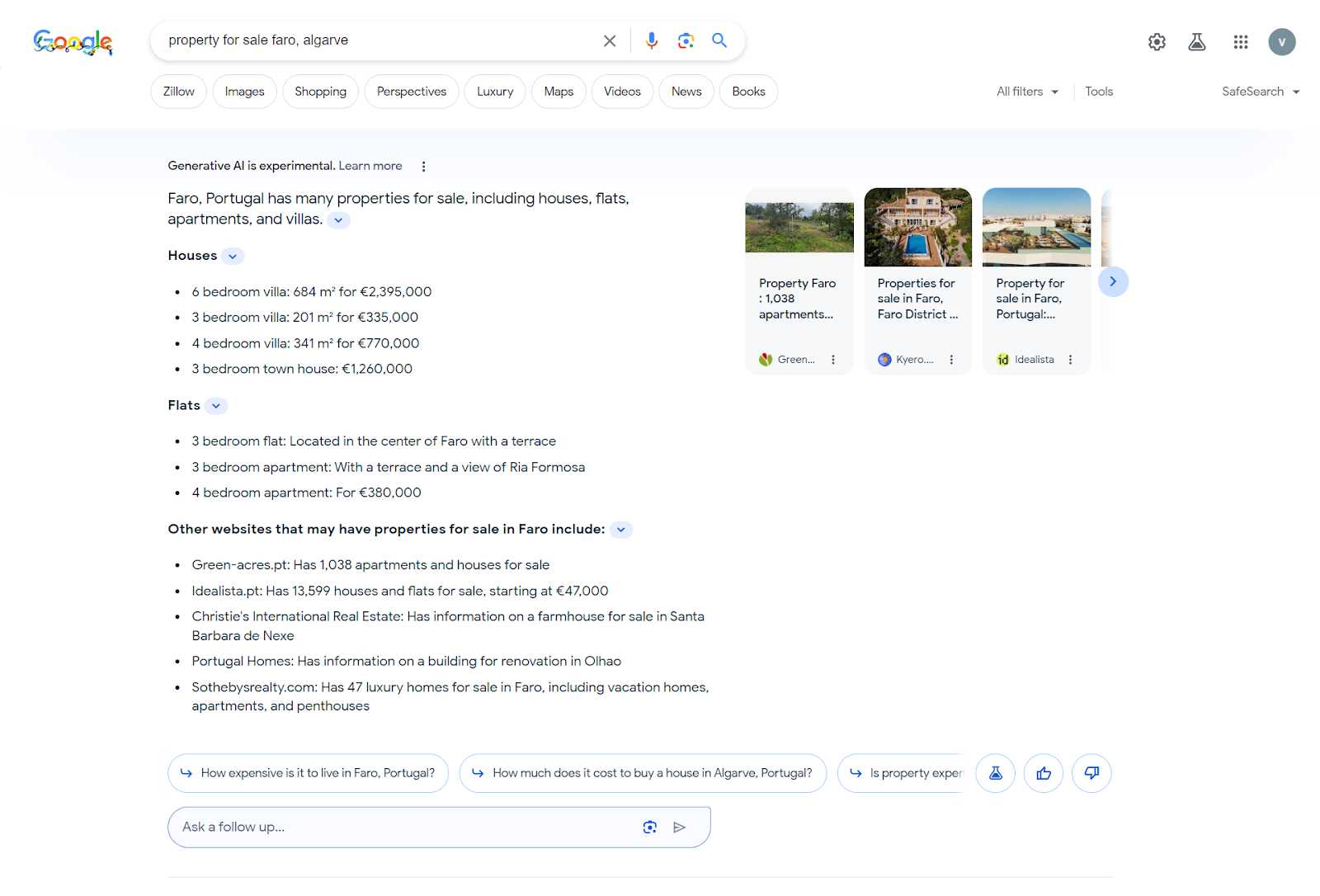
The panels within the SGE section may vary depending on the search query. For example in the first image we search for "property for sale in faro algarve".
We see the following panels in the SGE section:
AI generated response snippet
We see the AI generated response on the left side, in which the first panel is the AI snapshot, a snippet on top aimed at answering our query. This panel appears at the top of every SGE result. The pulldown menu button beside it reveals the same carousel as you see in the right hand column.
Carousel
In the right hand panel is a carousel which shows 6 cards with links to websites, but only 3 are visible without pressing the scroll button. This carousel appears on the top right of every SGE search result and we can consider this to be the "prime real estate" on the search results page.
The Carousel is made up of the source websites that the AI is using in order to create its answer in the Snippet and the Information Panel.
Information Panel
Under the snippet on the left is a panel with more information.The content of this varies across search terms as you will see in the examples below. In this case it is giving us information about property types and their price ranges.
Follow up Panel
Beneath these panels, we see some example follow up questions as well as a field where we can ask our own follow up question while keeping the context of the original search. This section also appears on every SGE search result.
Search for Real Estate with SGE
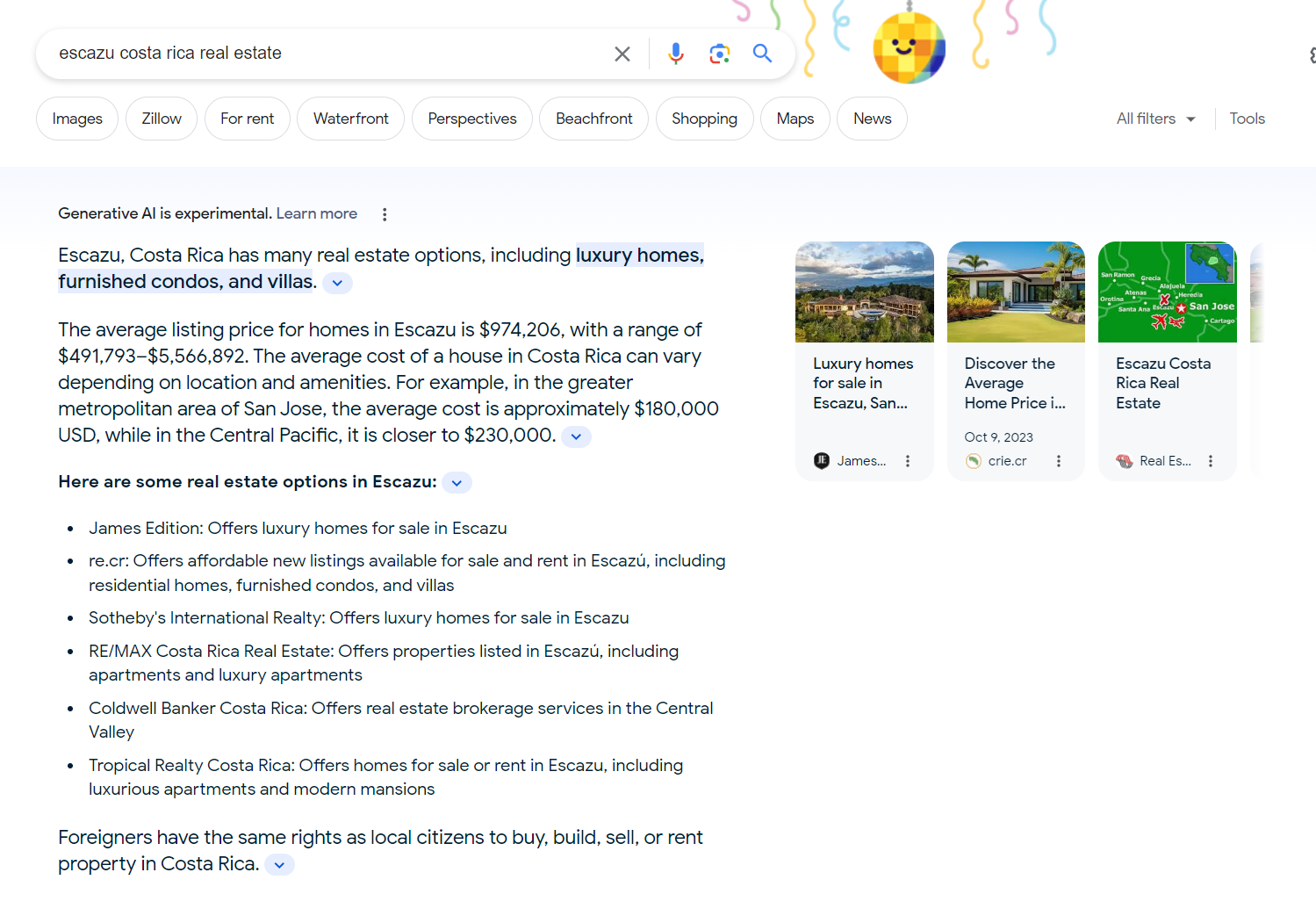
If we change the search query to "escazu costa rica real estate" the SGE Information Panel is not giving us property types but some average prices for areas in and around my searched location, the names of real estate agencies (without direct links to them) and the answer to a frequently asked question.
A search for a broker with SGE
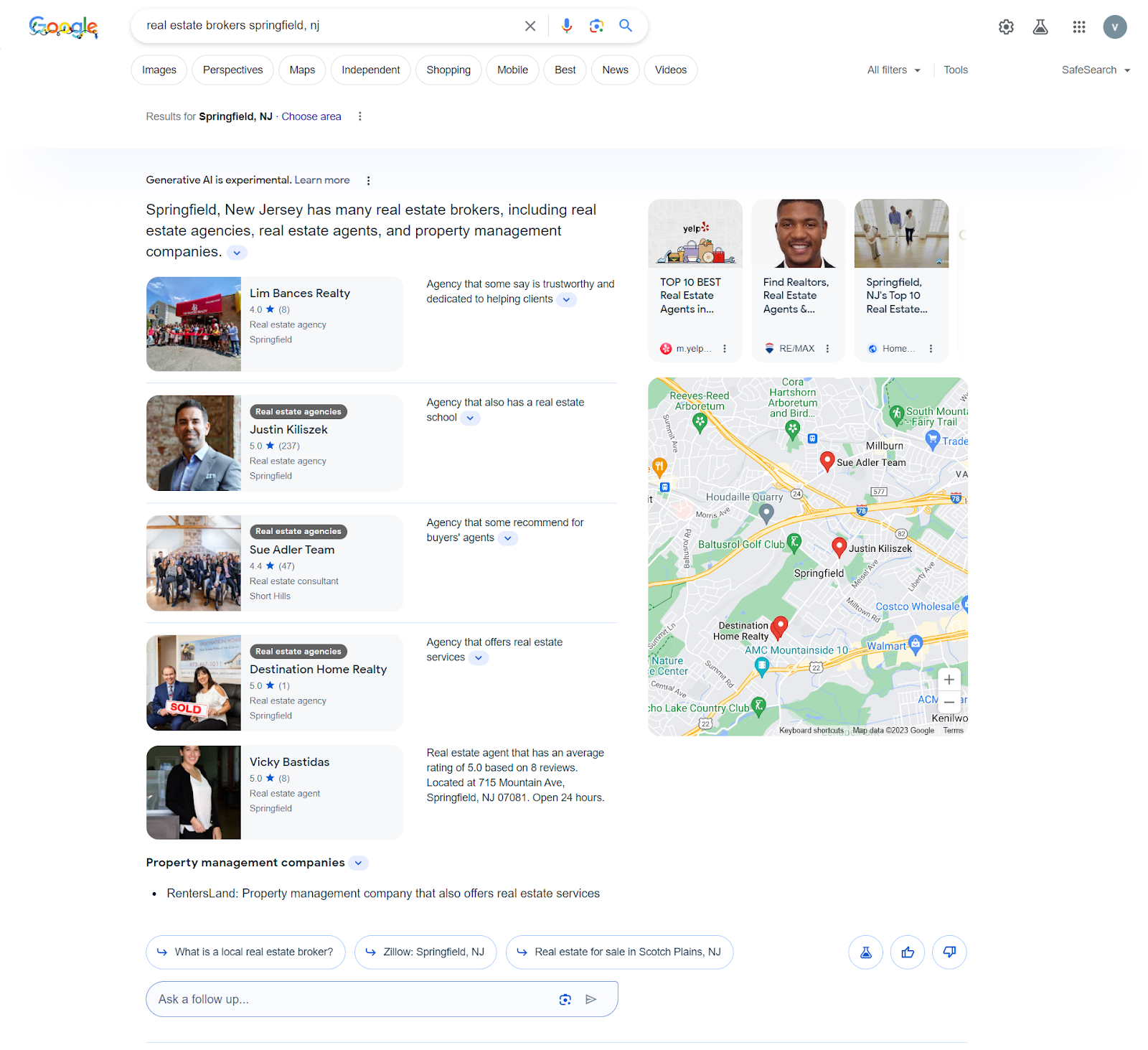
In this next example, we search for "real estate brokers springfield, nj" and we see an SGE section with the AI generated response snippet, Carousel, and follow up panel are there as before but the key difference is the Information panel.
Google is now giving us links to specific brokers, review ratings and an AI generated sentence about each one.
The Best Place to Rank in SGE page for Real Estate Searches
There is no doubt that in the new SGE page layout, the key position that will get most traffic is the Carousel.
The Carousel shows the web pages that SGE has used as a source for the data it has interpreted in the Information Panel.
Property for sale type searches
Real estate agent type searches
Information about the real estate process
Each type of search has its own information panel. So getting into the Carousel we need to ensure that our web page content is aligned well with the query. We’ll be talking about how to do that in our next article.
SGE for Real Estate SEO summary and conclusion
Google Search Generative Results (SGE) is a new feature that will be rolling out in early 2024. SGE will display AI-generated panels of information and links related to the user’s query at the top of the search results page, above the organic listings.
SGE will dramatically affect real estate website visitors
SGE will reduce traffic to many real estate websites because it will answer many user queries directly, without requiring users to click on any links.
SGE will change which websites gain the lion’s share of traffic because the links displayed in the new panels will take the lion’s share of traffic.
The best positions to rank in SGE:
The best positions to rank for are the Carousel so web pages need to show content that is aligned with the query.
The Information Panel may provide further links but this is dependent on the panel content displayed for the query.
Future of real estate SEO:
Real estate websites need to adapt to the SGE changes in order to maintain or grow their traffic.
Read our next article to discover how to rank in the SGE Carousel.
Real estate SEO is the most important part of real estate marketing.
Ranking high in Google search has never been as important as it is today.
There has been a digital transformation happening in the real estate industry for the last decade and the Covid-19 pandemic accelerated things.
Buyers, sellers, landlords and tenants are all online and you need to be too. If your potential clients cannot find you on the first three pages of Google you don’t stand a chance of getting their business.
To be honest, most business is generated from the first page but you can still get some leads from the second and third pages.
That is what real estate SEO does, if done correctly, it increases your ranking in search and your domain and page trust scores.
The only problem is that SEO can be very confusing and complicated to understand if you have no experience or training with it.
I wrote this guide to answer all of your real estate SEO questions and give you a comprehensive strategy to use it effectively for your business.
SEO stands for Search Engine Optimisation which is the process of improving the ranking of your site in search engine results pages.
The goal is to increase the amount and quality of the organic traffic to your website.
There are quite a few factors that contribute to complete real estate SEO and each one should be given the same priority and effort to get great results..
Content creation
Technical optimisation
On-page SEO
Off-page SEO
Why is SEO important for real estate agents
Real estate SEO is the most effective and long lasting marketing strategy there is. Nothing else will give your business the foundation to succeed for years to come.
As with everything else these days, real estate is happening online and people are using search engines such as Google for all their purchasing needs.
If you don’t have strong consistent SEO you won’t show up to people shopping online.
That is a recipe for disaster!
The benefits of real estate SEO are huge.
Increased number of high quality leads
Prospects at the right point in their buyer journey
Elevated brand awareness
More sales and profits
Marketing that continues to work forever
Lower cost per lead and cost per sale than traditional advertising or pay-per-click
How much does real estate SEO cost?
This is a difficult question to answer as it depends on so many factors. The cost isn’t purely financial, there is a time cost that needs to be factored in.
The questions to ask yourself when trying to determine cost of real estate SEO are:
Are you doing real estate SEO by yourself?
Have you hired an agency?
How bad is your current technical SEO?
How often will you perform keyword research?
What frequency will you update the content marketing plan?
How many pieces of content will you produce each month?
Will you include blog videos in the content creation and distribution?
Will you be producing separate short videos for social media?
There is more to it but this certainly shows you that it is hard to give a definitive answer to the price question.
Content creation is a bit like a tap, the more you open it the more that comes out. It really is up to you how much content you create and how much money you spend.
Can you do real estate SEO on your own?
Again, this is a complicated question but the short answer is yes, of course, you can do real estate SEO on your own. The catch is that you have to know how to do it and you have to find the time to do it.
Most real estate agents don’t even have time for lunch most of the time, so being able to start freeing up hours a week for focused SEO work seems like an unachievable task.
However, there are a small number of agents that can do it. If you are one of them then we applaud you and wish you the best of luck with your results.
For everyone else that is pushed to the limit everyday working with new clients, transactions, rental agreements and other miscellaneous admin tasks real estate SEO will be impossible.
My conclusion is that doing real estate SEO effectively and with longevity is not possible all on your own but if you want to try to be one of the few that succeed at it I hope this guide helps you.
Why hire an agency for your SEO?
When there’s a lot to learn followed by hours of putting it into practice, we’re often better off hiring an expert. From accountants and lawyers to housekeepers and hairdressers, our professional and personal lives are full of experts to help us.
In all marketing there is loads and loads of trial and error to go through while you are determining what will work best and what isn’t worth your time.
Why not hire an agency that has done all that already, has the formula to succeed and wants to use it for your business.
The benefits are substantial when considering if you should use an agency for your real estate SEO.
Quick results as they have been through all the trial and error already
You don’t have to get involved or try to learn the technical aspects of website SEO. They have (or they certainly should do) that down to a science.
No searching for copywriters, video producers and graphic designers as they will have that as a one stop shop
You will get value for money with regular reporting and results meetings
In short, hiring an agency is really the only way to go if you want to jump up the Google rankings quickly and be the envy of all your competitors.
How much real estate SEO should you do?
This is a question I get asked all the time and the answer is always the same.
You should do the keyword research and make the content plan first before even thinking about the quantity of content.
Then and only then you can decide at what rate to produce the content. Remember it is like a tap, the more you turn it on the more content comes out.
But just like water from the tap, the more content you produce the more it will cost you.
It goes without saying that the more content you produce, the faster your website will gain authority in Google.
Our advice, budget as much as you can to content creation and distribution as it will pay off 10 fold in the future and keep paying for years to come.
How long does it take real estate SEO to work?
This is probably the most frequent question I get asked about real estate SEO. And it’s a very hard one to answer because every client and every site is unique.
Also, people who budget high and produce a massive amount of content get results a bit quicker as well.
The industry standard says 6 to 12 months to see significant results from your SEO efforts.
If the goal is to increase traffic to your site in a lasting and meaningful way then yes, I would agree. However, with real estate SEO you can see some quick results if you do things correctly.
Using things like shortlists and location pages (we will discuss this later) you can quickly start appearing to people looking for really specific things. The speed of this will depend heavily on the competition for the search terms.
There is no definitive answer but if you build a solid, long lasting foundation that generates quality consistent traffic and continue to produce it will consistently bring big results.
What’s the difference between paid search and SEO?
The difference between investing in pay per click search and SEO is like the difference between renting and owning. One will still be yours tomorrow and with the other way if you stop paying, you’re homeless. Or leadless in this case.
Paid search has no lasting benefit. it only attracts visitors as long as you are paying.
Once you stop paying you stop showing up in search and no authority has been gained for your site. No lasting foundational effects.
Real estate SEO is a combination of tune up and adding new and exciting content to your site. You end up owning this content and it will work for you forever.
It’s like having an ever growing library of useful information that builds trust with your prospects and the librarian. Well the search engine in your case.
The more you do the more that authority increases.
Both are useful tools to you and should be used to their best advantage.
Paid search is direct response advertising that is used when you need leads and sales quickly, just remember to test, test and test some more when creating adverts.
Real estate SEO is a longer game that builds you up as an ultimate authority to search engines and your visitors.
How to do real estate SEO
For real estate SEO to be effective you need to follow a set process. A process that Respacio has perfected over the years.
No matter the client we work with, everything always starts with learning and research then planning then action.
If you follow these main phases and the instructions below you will succeed beyond measure.
1. Learning and research
This is the most important part of real estate SEO and cannot be overlooked or rushed. It is the basis for everything you will do afterwards.
Arming yourself with as much research and knowledge as you can is worth its weight in gold.
Imagining the ideal client
At Respacio, when we start any real estate SEO project we always start looking at the ideal client first.
You will want to have a great understanding of your typical clients as well as your ideal clients to draw the correct assumptions here.
You might be saying that you know your clients already. That could be the case but chances are you don’t have it written down or made into a real imaginary person.
Things like age, interests, gender, marital status etc etc can be used. The more detail the better because you want to put yourself in their shoes whenever you’re thinking about content creation.
You want to dive into their pain points and motivations and explain why they do business with you. You can also describe their typical day to really get a sense of them.
Once you have your ideal client completed, you will be well acquainted with exactly whom you are doing all this SEO work for.
Remember that just like a real person your ideal client should evolve and grow. As your business grows, use interactions with clients and peers to constantly update the ideal client.
You may also need to create and imagine multiple different ideal clients for the different services you offer. In the beginning start with one and grow from there.
Local industry
Now that you know who your ideal client is and you have expert knowledge about them you need to have the same information to hand for your local area.
This could be a big area like London, Toronto or Malaga or it could be a small town or village that you operate in.
You will want to know all about market trends, local events, population statistics and marriage and divorce rates.
Knowing the local area well helps you gauge how your ideal client is likely living and what their life is like.
Real estate SEO keyword research
In real estate SEO there is nothing more important than keyword research.
Nothing.
This is where you start to really get down to the nitty gritty of what your ideal client is searching for in search engines.
To build the best keyword list possible you will need to employ several tactics. Using them all will make your list indestructible and give you the greatest advantage.
Brain dump as many search terms you think your ideal client might search for, for any of the services you offer
Start googling some of the best terms from the brain dump and Google will give you related searches and people also search for
Use software like SE Ranking, Semrush or ahrefs to extract all the keywords that your competitors are ranking for and pick the best ones
Using Google keyword planner to get related and similar keywords to the ones on your list.
Use A.I. such as ChatGPT or Meet Bard to expand on your list and get some great long tail keywords
Add all your locations from your location tree to the list
Add all your shortlists from your website to the list
If you want a list of some of the top keywords we use for our real estate SEO then you can click below and download them free. It will give you a great base to start from.
Current technical health and speed investigation
Even though keywords and content creation is most of what drives real estate SEO, if your site is not technically sound and cannot pass Core Web Vitals among other technical tests, all of your efforts won’t matter.
Luckily if you address these technical issues once, all that will be required moving forward is maintenance.
Similar to a car, if you treat it well and give it the service and updates it requires it will run the way it should for a long time.
There are multiple software programs that can tell you all you need to know about your website’s technical health and speed.
The team at Respacio uses a whole array of software and tools to understand every aspect of technical real estate SEO.
Current on-page real estate SEO audit
During this part of the process you need to go through each page on your website and go through a checklist to make sure everything is set up optimally.
You will want to check the following:
SEO title
Is there one?
does it have the target keyword at the beginning if possible?
Is it relevant to the content on the page?
Is it the ideal character length?
Meta description
Is there one?
Does it have the target keyword at the beginning if possible?
Does it marry with the SEO title?
Is it below the recommended character length?
URL
Does the url for the page match the SEO title or match closely enough?
Is the url small and easy to read?
Images
Is the alt text relevant to the content on the page and to the image itself
Is there a title for the image with the targeted keyword in it?
Videos
Are all the videos on the site embedded from your YouTube channel?
Is a video schema used to signal search engines
Internal and external links
Are there any broken links?
Is all the anchor text for the outbound links relevant to the link destination without generic link terms
After you have completed this audit you should have a full list of all the on-page real estate SEO issues that need to be addressed.
Current off-page real estate SEO audit
This is where you need to check up on the quality of the activity happening outside of your website to enhance your domain’s authority and rank.
This is generally judged by the quantity and quality of your backlinks. There is software such as SE Ranking, Semrush or ahrefs that can give you excellent backlink reporting and tracking.
Backlinks are external links on other websites pointing to your website.
This is very important to pay attention to because backlinks from other websites act as a form of an approval to search engines.
That’s why I say check the quality as well as the quantity because the more reputable the referring source the better results will be.
2. Planning
Now that you are armed with all the information and data from your research you can’t just jump right into conducting real estate SEO.
As with everything in business and life, you need a PLAN!
With a well laid out plan you will be able to get results much quicker and be earning more money before you know it.
As part of your larger real estate SEO execution plan you will need to have sub plans to cover everything and make sure you aren’t missing anything.
Keyword distribution plan
Just having the big keyword list you made in the learning and research phase of real estate SEO isn’t enough.
You need to plan out what pages and areas of your website will be targeted by which keywords. This makes the content creation process more of a system than a free for all.
Remember it is very important to look at the current content on your website because making new content that is targeting the same keywords as existing content is very confusing to search engines.
So, once every existing page has a keyword or keywords assigned to it you have the beginnings of your content marketing action plan.
But that’s the third step of the planning phase.
Site optimisation plan
Now that we know what keywords are being targeted and where, we need to make sure that each of these pages is optimised to do it.
You will want to put this plan on the screen in Google sheets for instance so you can list what each page already has and what it needs.
If you want to download our free site optimisation Google sheets template you can click below and get it.
As you can see it is a simple table showing what each page has and what each page needs.
You also want to make sure that the structure of your site makes sense.
If how the category pages and subpages are organised is confusing to you then it will certainly be confusing to the Google crawler.
It needs to be easy and simple to understand.
You will need another Google sheet to list out the hierarchy of all your pages noting the parent and child relationships.
If you want to download our free site structure template then click below and get it.
Real estate SEO content marketing action plan
When it comes to content creation for real estate SEO the content marketing action plan is critically important.
This will tell you or the team creating your content what to create, what assets are needed and when to create it.
Having this all in the form of a plan is a great way to track your progress and know what is coming.
A typical plan will be laid out in a table and list the keywords to be targeted in the first column. The details of how and with what assets those keywords will be targeted follow in the columns to the right.
We always use a simple Google sheets template for these content marketing action plans at Respacio and you can download it free below.
A content marketing action plan should be a maximum of 6 months long because the SEO and content creation space is ever changing and 6 months for reviewing and updating the plan is ideal.
With 6 months of data you can make very accurate decisions about which content works and which doesn’t.
Technical health repair roadmap
Finding out the technical issues of your site is only half the battle. You need to have a concrete plan and timeline to get them fixed.
You should be asking yourself some questions here.
Who will perform my technical fixes?
What kind of budget do I want to, or can I, assign to these technical fixes?
Could a new website be a better option time, money and results wise?
When you have answered these questions you can make a plan and the most important part of the plan will be the scope of time.
Make sure you get accurate timelines from the technical team and hold them accountable throughout the process.
Backlinking and off-page SEO strategy
The best off-page and backlinking strategy for real estate SEO is to create amazing valuable content that people will want to point to from their websites.
It is like social media, if you make great content and promote it people will share it.
As I said above, the quality and relevance of the backlink matters the most now.
So you need powerful authoritative websites in your industry to have external links to your website on their sites.
Even though having valuable content will generate backlinks on its own you still need outreach to promote it if you want to see fast beneficial results.
Using software tools like SE Ranking or SEMRush you can check what backlinks your competitors have and promote your content to them.
The important part is to have the strategy of content promotion and to put it into a scheduled and itemised plan so you can take action effectively.
Action
It is now time for you to start putting your new found knowledge and plans into action.
This is where your website becomes what it was meant to be.
A lead producing machine!
Optimise the site
Getting the current site, as it is, up to date and in line with your plans is the first step to real estate SEO action.
According to the site optimisation plan you will:
Ensure every page has an SEO title that is in line with the targeted keyword and is less than the viewable maximum of 55 to 60 characters.
Pro tip: Put the targeted keyword at the beginning of the SEO title for best results.
Edit or write meta descriptions for each page making sure the targeted keyword is included and the length is below the viewable maximum of 150 to 160 characters.
Add alt text and titles to at least the featured image of every page to let search engines know what the image is and what it represents.
Create a video structured data markup schema to let search engines know about your embedded videos. This could also be on the technical SEO section but really is on-page SEO optimisation. This needs to include details such as title, description, video length, upload date and thumbnail.
Once this is all complete and you have checked everything off the on-page optimisation plan your website will be ready for new amazing content according to the content marketing action plan.
Real estate SEO content Creation
This is it, the main beef of real estate SEO.
Creating great, valuable content that will answer the questions people are searching for in search engines.
This content is created according to the content creation action plan that was drawn up earlier.
It is quite important to remember that the quality and accuracy of your content is more valuable than ever. Gone are the days when writing a substandard piece of content littered with keywords would give you authority.
Google is getting smarter and smarter and their mission is for you to find the answer you are looking for in search as fast as possible. That means they don’t want you to have to check lots and lots of search results to get to the one that you need.
This indicates that the content that they return to people searching has to be very very good.
This is where modern day real estate SEO comes in.
You either have to be a dedicated and talented content creator or you contract the services of a content creation agency, like Respacio.
If hiring out these services is not for you or not in your budget then keep reading to find out the best way to make great content for your visitors and for the search engine algorithms.
Written content
Written content is a major part of real estate SEO and should be considered the foundation that the rest is built on top of.
Written content varies in its purpose, tone of voice and length depending on where it’s being used on your website.
Although written content can appear in many places on a website there are five main areas that are the most important for real estate SEO.
Blog articles
Location pages
Shortlist pages
FAQs
Main pages content (homepage, about page, buy page, sell page, etc)
Whichever type you’re writing you need to make sure you are optimising for the target keyword. This is indicated in the content marketing action plan. It is also a great idea to have secondary keywords that are aligned with the primary keyword. This helps give your writing more relevance and therefore more authority.
The best practice is to start with an outline of the content you intend to write. The outline should contain the goal of the words that will be written and a list of the main sub headings to give you organisation when writing.
A good portion of these subheadings should contain your keyword in a natural and sensical way. If you just stuff keywords wherever you want and it doesn’t make sense your results will be poor.
Everyone has to find their own process for writing good real estate SEO content. Have a look at mine to give you some inspiration.
First draft
I don’t read back at all, I just write as a stream of consciousness
Edit into second draft
I go back and fix all the spelling and grammar mistakes and polish the writing into good concise thought.
Third draft
I edit it and pretend I’m speaking to one person. This could be my ideal client or a recent client whom you wish you had more of
Send it to the editor
I know, most of us can’t afford an editor, and that’s ok. Anybody that is good with writing and knows your voice can edit your work. This is an important step as a second set of eyes can make all the difference..
Final once over
This is the point where I take a good long read of it and make all the final tweaks and changes to really make the piece hit home. Check your keyword distribution at this point. You need to ensure there is a good number of them in the body text and the headings.
Add the props
Generally if I’m writing content I like to have images, infographics and statistics to drive my point home. It acts as a form of credibility.
Publish
Now all that’s left is to publish my work on the website. Make sure all your headings are correct here and to have all the images and videos optimised correctly.
Maybe my process seems long and arduous to you, and that’s ok. You will need to find your own method that works for you.
One good thing to remember is that the best writing is genuine and sounds like the writer.
Don’t get me wrong, if you are writing a piece on the effects of the tax burden on short term let owners you won’t want to speak like you do to your mates but you would most certainly want to sound like you would if you were addressing a table full of short term let owners.
Be you and people will relate to your writing.
Real estate SEO video content
Video is certainly the future of marketing and you need to get comfortable with it and it needs to be a major part of your real estate SEO content marketing action plan.
The real truth is that video consumption is winning over all other media types and the gap is just getting bigger.
For real estate SEO, videos are best used on your website as embedded youtube videos to add more value to the page where they are located.
Think about a blog about tax for short term lets. A lot of people don’t like reading and a clickable video at the top of the page explaining the blog article would be very very useful.
I personally recommend using head and shoulders videos of yourself talking about the subject matter. This is much more personal and people will feel more comfortable.
If you’re just not up for that then you can create videos using your own imagery and videos or stock items from programs like Adobe Stock, Envato or Shutterstock.
At the very least you will need to record a voice over for the video using a script that you write as a summation of the content on the website.
A script or some point form notes at a minimum are necessary so you stick to the message you’re trying to convey and don’t start rambling.
There is a time and a place for stream of consciousness videos and this really isn’t it.
Once you’ve recorded the video it will need editing and some b roll added as well as subtitles and clever headings throughout. You might want to put some music in the background but be careful with this as you don’t want to take focus off your voice.
Subtitles really are a must as a large percentage of viewers scroll and watch videos on mute. Think about all the people you see on public transportation scrolling through social media, they are all watching videos with the sound off so having captions is a non-negotiable.
Try and keep the video length to what is absolutely necessary. Be succinct and to the point so people don’t lose interest but make it as long as necessary to tell the story you are trying to tell in full.
With YouTube it is always better to upload a separate subtitle file instead of embedding them using your video editor. These are srt files and most video editors can export them in this format. This is important because YouTube will translate them if you upload them natively which means people with different language accounts will see them.
It is very important that your written content and your video content can both stand on their own. Remember people might come across the video on youtube and you want them to find it helpful in its own right.
Image Content
Images are constantly used throughout digital content to help reinforce and explain the subject matter.
They can also be used to trigger people’s interest and keep them on your site, video or page. They are even great to scatter throughout the written content to break it up and make it easier to read to the end.
Every YouTube video needs a thumbnail and you want to try and stay away from using the automatically generated still images from inside your video. These will be passed over in favour of a more standout and unique thumbnail.
Have a look at these two I used for two of my videos. Simple but effective. They draw your attention.
The other very useful place for images is throughout the body of written content on your website.
It really helps to break up the words on the screen and gives people some visual queues to better understand your point.
Make sure to always give images alt text and a clever title ensuring to include the keyword.
If you want to get really fancy you can make use of infographics which are visual representations of information and data. Text, images and charts are combined to communicate complex information in an easy to understand way.
Check out this example to give you an idea.
Backlinks are your friend
Now that all your new shiny real estate SEO content is ready and on the web you need to promote it. You want to showcase it as much as you can so that people will see it, share it and eventually link to it from their sites.
Remember the better the reputation of the site the better the backlink is. Getting a backlink from Joe’s used cars will not be as good as getting one from a big reputable house insurance company or mortgage lender.
There are numerous ways you can promote your content for real estate SEO backlinks.
Social media posts
Social media groups
Email newsletters
Email signatures of the entire team
Guest blogging
Submitting to directories
Commenting on other websites with links to yours
Press releases
The best and most effective way to get backlinks is, unfortunately, to be patient. Create amazing valuable content on a consistent basis and you will get backlinks.
Conclusion
Real estate SEO is a complex and very involved endeavour but an essential one if you want to succeed in today’s online digital world. Showing up to the right people at the right point in their buyer journey is critical to long term success. The only way to achieve that is with a comprehensive real estate SEO roadmap.
After reading this guide you should be educated and prepared to tackle the task with efficiency and confidence. You should now know:
What real estate SEO is
How much it costs
Why it’s important
If you should do it on your own or hire and expert
How much you should do
How long it takes to work
How to do it efficiently and profitably
What the three main phases of real estate SEO are
Phase 1: Learning and research
Ideal client profiling
Local industry investigation
Website technical health
On-page and off-page SEO
Phase 2: Planning
Keyword distribution plan
Site structure plan
Site optimisation plan
Content marketing action plan
Phase 3: Action
Optimising the site
Content creation
Written content
Video content
Image content
Backlinking
If you find all this a bit too much to do along with the enormous task of running your business please don’t hesitate to get in touch with us and find out about all of our amazing marketing services. You can check everything out here on our real estate marketing page.
Real estate web design is not something that can be shelved until you have time or be put on the back burner, anymore. Maybe it used to be, but there is a digital transformation happening in the real estate industry in Canada right now. Clients are all online, and, as a real estate agent, you need to be too.
One of the top priorities for you as a real estate professional in Canada is to have any and all MLS listings available to you on your website so potential clients can search through them easily and let you know which ones they are interested in.
As a realtor in Canada you want your real estate web design to include your MLS listings from your real estate board. There are multiple ways this can be done and we wrote this article to break them down for you highlighting the pros and cons of each and to give you our recommendation and step by step guide to do it for your real estate web design with MLS listings.
The goal of this guide is to take out all the complications and tech speak from real estate website design with MLS listings in Canada so that all real estate agents and brokers can understand it and make the most informed decision possible when choosing a real estate web designer.
So let’s start with something simple. The different ways to get the MLS listings from the MLS to your website for prospects to see. There are three main ways currently being used.
Real Estate Web Design with MLS Listings Using IDX
IDX is the most traditional method of real estate web design with MLS listings in Canada. This is the method predominantly used by real estate agents in Canada.
Basically, to help you understand what IDX is, think of a multi picture frame. You know, the kind parents give to grandparents with all sorts of pictures of the grandkids in them. IDX does that with your MLS listings, it puts them in a frame to be displayed and you can’t change the format you can only put it on display.
You are essentially stuck with the display format, calls to action and property information that the IDX provider designs and the real kicker is that everyone else has the exact same design so there is no uniqueness at all to yours or anybody else’s real estate web design with MLS listings.
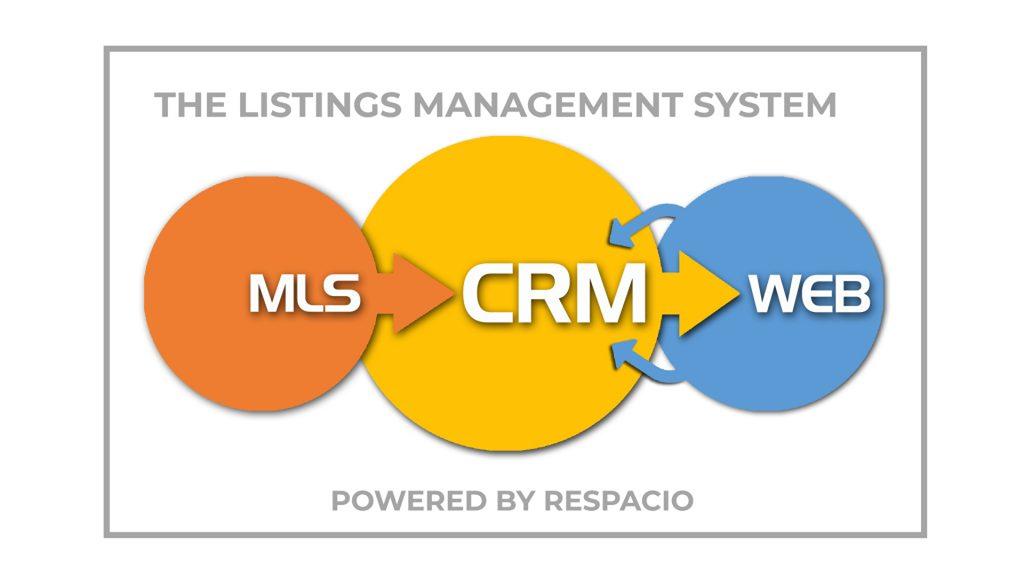
This system goes from MLS to your website with zero customisation in between.
Pros
Cons
Mostly a done-for-you model
You get all the MLS the listings on your site
People may be used to the display format
No access to properties in your CRM where all your customer data is
No style customisation possible
No display customisation possible
No Google search and ranking benefit to your domain
Your MLS listings will look the exact same as everyone else’s
No access to listing data outside the MLS portal
Your website will be marketing for your competition because you have no control over what’s displayed
Real Estate Web Design with MLS Listings Using IDX is really old technology and you should stay away from it. If you want to be at the top of your game and compete where the business is, online, then you need better tools. Tools that will allow you to showcase your MLS listings in a way that matches your brand and your service and keeps all your properties and clients in one place, the CRM.
Real Estate Web Design with MLS Listings Using an API
Real Estate Web Design with MLS Listings Using an API is an updated version of IDX and is the new standard in Canada for getting MLS listings to your real estate website.
Using the previous example of the picture frame we can explain API so you will understand it. There really is no frame with this method, just a big stack of pictures that you then have to build a frame for in order to display them. This frame is, of course, your website. This can get difficult and expensive if you don’t know anything about building picture frames or, more accurately, have any experience in real estate web design with MLS listings.
So, with an API you have all the MLS listing information and you then need a programmer or a third party piece of software to make those listings appear the way you want and manage them moving forward.
This system goes from the MLS to your website with customisation possible in between but this customization comes at a time and a financial cost.
Pros
Cons
Some control over how MLS listings are displayed on your website albeit expensive control
All MLS listings will be on your site
Can be an SEO friendly way to display listings
No access to properties in your CRM where all your customer data is
Requires more software to work
More expensive
Delays waiting for website changes
Relying on others people and software to run your business
Higher cost than IDX
Real Estate Web Design with MLS Listings Using an API is a much better option than the old IDX real estate websites but it still isn’t the right system to stay competitive in a digital market that is changing all the time. You need to be able to combine all of your data in one place and operate from one piece of software, your CRM.
Real Estate Web Design with MLS Listings Using Respacio’s Listings Management System.
Real Estate Web Design with MLS Listings Using Respacio’s Listings Management System is the most effective way to achieve the result you want because it is built right into the CRM. It is modern, state of the art and super easy to use.
If we go back again to the example of the picture frame we can illustrate how our system works. Think of your Respacio website as one of those digital picture frames that is always changing images and now think of the Respacio CRM as the database and engine inside that frame telling it what photos to display, how they should look and when they should appear. The beauty of it is that you are the one controlling the engine.
So, with the Respacio listings management system your real estate web design with MLS listings can be exactly as you imagine it. All the calls to action placed to encourage the most conversions and only the property information you decide you want to show needs to be shown. A true custom real estate web design with MLS listings.
At Respacio, we are already a registered partner of CREA (realtor.ca) and have the API set up and ready to build a connection to your site.
This system goes from the MLS to the Respacio CRM and then to your website with limitless customisation possibilities.
Pros
Cons
Connected directly to the CREA realtor.ca API listings feed as Respacio is a registered partner
Properties are in your crm where you can use and control them
You decide what information is sent to your website
Property matching with client requirements happens in the CRM
You can set up shortlists, location pages and featured properties at the touch of a button which is incredible for Google search ranking
Be able to target the right areas in your content marketing plan with most searched for and viewed locations, properties and shortlists with real time reporting in the CRM
A whole new way of working to get used to
More initial work to plan, design and build
Higher cost than both IDX and API
Real Estate Web Design with MLS Listings Using Respacio’s Listings Management System is a much better option than both the traditional IDX and the newer API technology. It gives you the control you need over your real estate web design so you can set your business up with a foundation that will:
Attract more website visitors than ever before
Convert a higher percentage of those visitors in good quality leads at the right point in their buyer journey
Help your team close more sales than they ever have
If you are thinking of a new real estate website or you are just starting out and need real estate web design the best place to start is our article How to plan a high performing real estate website.
How to get started and implement real estate web design with MLS listings using Respacio’s listings management system.
Respacio is not a cheap out of the box system, it is a powerful sophisticated system that will change your business and your life if you follow the right implementation and use process into your agency.
The seven steps below give you an outline of the process our clients go through when they get real estate web design with MLS listings using Respacio’s listings management system.
Step 1 – Take our real estate CRM for a test ride and subscribe
The first step to building your new real estate website with Respacio’s listings management system is to have a demo of the Respacio CRM and book a 14 day free trial.
During that 14 days we will import some contact and property data for you to play around with and train you on the system.
You will learn how:
To find the incoming feed from realtor.ca and how to adjust the settings
To make permanent changes to individual properties that won’t change next time the feed is called.
To use marketing features to highlight selected properties on the website
To create and take advantage of shortlists to target keyword searches
To create contact and property records from scratch
To set up contact deals requirements and run property matches
Now that you have experienced the software and have had some general training you are ready to subscribe to the program that best suits your needs. See all the plans and prices here.
It’s at this point that we set up the system for you and your team, if you have one, and assign everyone a user and onboard them.
Step 2 – Import all your contact data
The next stage of real estate web design with MLS listings using Respacio’s listings management system is to get all of your data into the crm, starting with the contacts.
The system makes it very easy to do this using a spreadsheet import. We even have a template sheet you can use with an example in it for you to follow. If you really don’t want to attempt it we also offer a done for you service.
Either way we will first need to examine where your data is being stored and what is the best way to extract it and get it onto an import sheet.
During this process, because the system is completely customisable, a Respacio business analyst will work alongside you to add new fields you need or hide existing ones you won’t need. When you are finished your contact record will contain the data you need it to and the layout of the information will be exactly how you want it.
Step 3 – Build the API feed from CREA (Realtor.ca) to the Respacio CRM
This is really what makes real estate web design with MLS listings using Respacio’s listings management system truly the best and most effective method on the market today.
As we are already a registered CREA partner and have the Realtor.ca feed built, all that needs to be done now is for you to decide what areas you want to have listings displayed for and we will do the rest.
In no time at all, all your listings will appear in the properties section of your crm with all the information there for you to work with.
Because the system is completely customisable we will create new custom fields, attributes and features to match the incoming information.
Now that the listings are in your system and being constantly updated it’s time to decide how you want to manipulate the information to display on your website but first we will need to complete the most important step of the whole process, the planning.
Step 3 – Planning a high performing real estate website
At Respacio, we put a huge emphasis on this step of real estate web design with MLS listings. This is where everything is decided that will affect the success or failure of your site. We need to get this right.
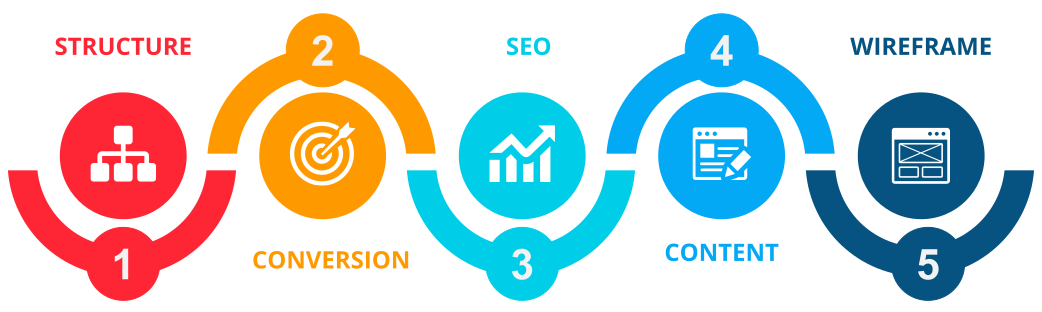
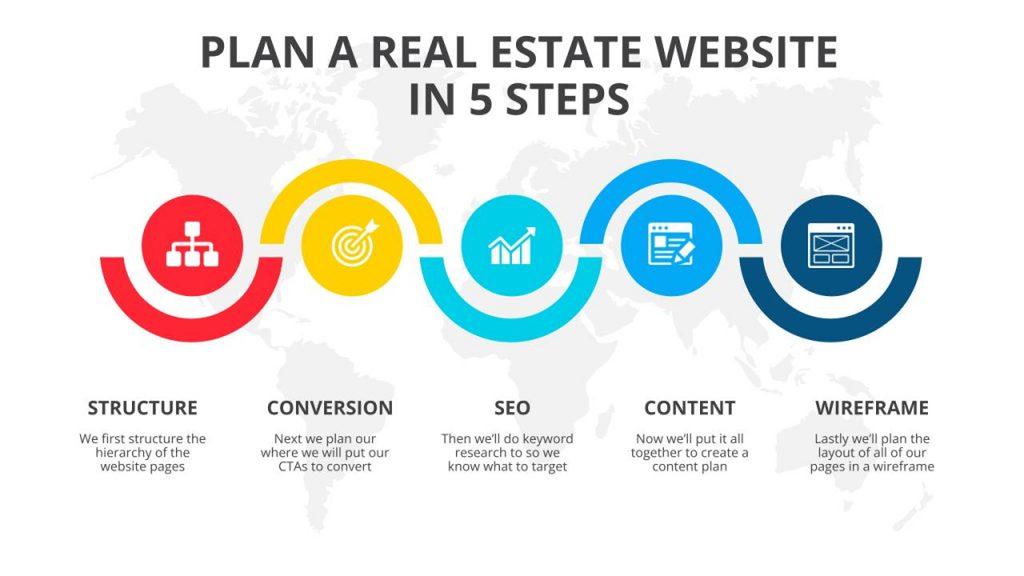
Planning is done in 5 stages:
Structure
Conversion
SEO
Content
Wireframe
Get this right and your real estate web design with MLS listings will deliver results beyond what you imagined possible.
We wrote an article called How to plan a high performing real estate website in 5 steps if you want to know more in depth information on this critical step of real estate website design with MLS listings using Respacio’s listings management system.
Step 4 – Build an API feed from the Respacio CRM to your website
The MLS listings are in your system now and set up the way you want so the only thing left to do is to build an API feed from the CRM to your new website.
You don’t have to worry much about this as our technical department will take care of it all. They may have some initial questions about what information you want to display but your business analyst will liaise with you for everything and keep you up to date with the progress.
Once this step is completed the engine portion of your website will be complete. If we go back to the picture frame example, you are now ready to send the pictures (your listings) up to the digital picture frame (your website)
The MLS listings on your website will be:
Exactly how you want them to appear
In the order you want them to appear
With the information you want to show
Step 5 – Design the frontend UX (user experience) of your real estate web design with MLS listings
Now is finally the time for your creative process to come out and for the look of your real estate web design with MLS listings to start taking shape. Usually at this stage our clients have a graphic designer of their own or we refer them to one that we have worked with before.
This stage is completed in the same Adobe XD software and is created over top of the wireframe we made step 3.
Once it is complete and signed off by you then we move on to customising your crm even more and we pass the completed Adobe XD file over to our WordPress development team so they can get started bringing your vision to life.
Step 6 – Create your identity in the CRM
Ok, to really make the most of your real estate web design with MLS listings using Respacio’s listings management system you need to get your CRM into fighting shape.
This means we need to build your real estate pipelines to match all the processes in your business.
Pipelines are essentially all your systems and processes laid out in stages with deals (contacts plus their requirements) that move through them in a left to right manner.
Real estate workflow pipelines are a very important part of the listings management system and we can’t cover everything about them here. If you want to know more about them read the article, Guide to Real Estate Pipeline Stages.
Having consistency across your messaging is critically important to your real estate web design with MLS listings using Rewspacio’s listings management system.
At this stage we will build, design and implement all your templates and automations.
By templates we mean the property match emails, pdf brochures, chaser emails, appointment confirmation emails and windows cards, among others.
By automations we are talking about setting up as many automations as we can with the Respacio automations module so all the boring and overlooked admin and follow up tasks will be done for you.
Think about 10 chaser emails being sent over a 2 week period or automatic emails being sent out to new enquiries with links to your website as well as similar properties they might be interested in.
Have a look at the article, Automated email follow ups to learn more about how we use automation to help you win more business and make more money.
Step 7 – Build and develop your new real estate web design website
Now it’s time to hand over the reins to the tech team so they can build and develop your site according to the specifications that have been laid out in the previous 6 steps.
We promised at the beginning of this article to keep it simple and not get too techy so we won’t.
Our websites are some of the fastest and most secure real estate websites in the world.
Our team of developers will use all the latest tech, security and trends to build you a site that will exactly match your design and plan and that will pass all the speed and security tests necessary to compete in today’s fast paced digital world.
Before we launch you will be given a demo link so you can thoroughly review and test the site before actually going live.
Step 8 – Launch your site
Finally, after all the planning, designing, developing and testing you will be at the finish line and ready to launch your real estate web design with MLS listings using Respacio’s listings management system.
Now all the properties available to you from your MLS will be displayed on your website the way you want them to be and in a way that helps convert more visitors into leads.
Remember, you will also be able to edit the info in your CRM and change the way things appear on your real estate website at the touch of a button
Conclusion
By now you should feel very confident knowing:
What is the best way to get your MLS listings onto your real estate website
How Respacio’s real estate web design with MLS listings using the listings management system works
Why it is the best system to make the most money in our ever increasing digital world.
If you would like to speak to a business analyst regarding your new real estate web design with MLS listings then fill out the form to your right and we will be in touch with you right away.
Choosing the best real estate website designer can be a very confusing process. There are so many factors to consider and so much information out there on the internet to sift through.
If you haven’t noticed there is a massive digital transformation taking place in the real estate industry right now. This means the quality of your website has become monumentally more important than it used to be. So, the quality of your real estate website designer is more critical than ever.
The biggest problem that real estate agents face is that so many real estate website designers either focus too much on how the website looks and the graphic design instead of making sure it will drive traffic, leads and sales into their business or they simply don’t know how to SEO optimise a real estate website that is conversion focussed.
With that in mind we wrote this article to give people all the information and tools they need to choose the best real estate website designer.
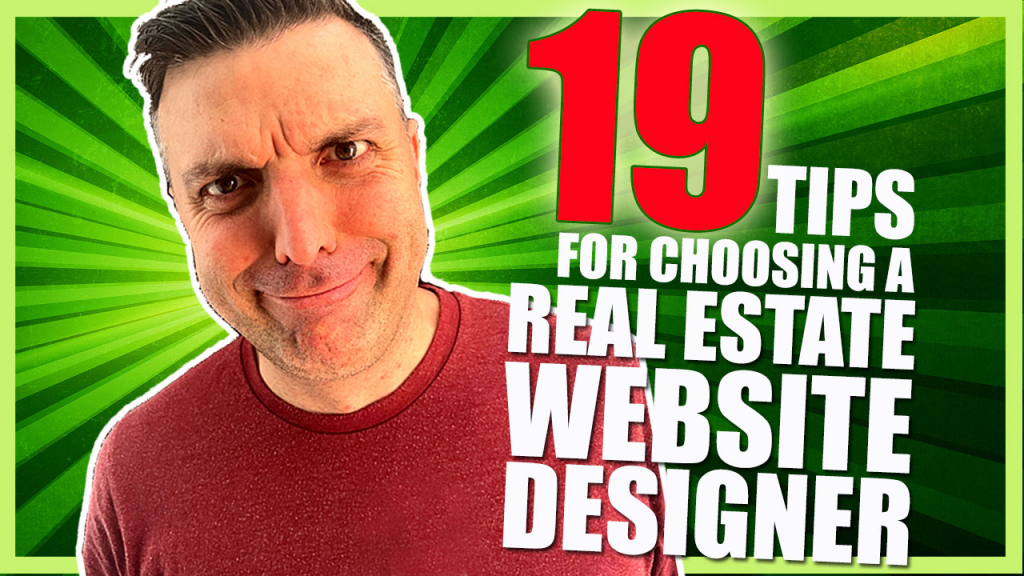
Have a read through our checklist of the 19 things that you need to tick so you choose the best real estate website designer.
If you can check them all off then you are in safe hands and can be sure your real estate website will do what it is supposed to, attract the right visitors at the right point in their buyer journey and convert those visitors into leads.
#1 Does real estate website designer plan before they build?
The best real estate website designers always work from a plan that gives them direction and parameters when they go to the design and build phases. By the way, that the 3 main phases a great real estate website should go through.
To make my point, I want you to imagine for a minute, a construction company started building a building without architects and engineers first planning and creating drawings. It would be a disaster. If the building didn’t fall down soon after it was built it would only be a matter of time.
The same goes for a real estate website that is designed and built without a plan. In today’s digital age the success and failure of your real estate agency will depend on the success of your real estate website and therefore the quality of your real estate website designer.
The best real estate website designers work from a detailed, bullet proof plan.
#2 Does the real estate website designer have a process?
In the last section we told you to check that your real estate website designer works from a plan. To do this you will need to see their process. A documented step by step journey that you and your new website will follow.
To be clear here, a wing and a prayer is not a process. The process should be documented, preferably on their website, so you can see exactly how they will plan, design and build your site.
The reason the best real estate website designers have documented processes is because they are organised, efficient and have obviously tested enough methods to be confident enough to promote their process.
If there is no process to be found then take them off the list and move on.
At the very least they should separate the process into three main high level stages
Planning
Designing
Building
But to be honest these main phases should really be broken down into sub stages and further into sub steps.
The best real estate website designers have a documented and easy to understand process.
#3 Do they understand your business?
To be one of the best real estate website designers, they will need to ask a lot of questions and do a lot of research.
You should be on the lookout for how much investigation any real estate website designer is doing. The more they do the better they will know your business.
The more they know your business and your clients the more suited your website will be to converting the right people.
Sometimes it’s a good idea to get a specialist real estate website designer that has in depth and intimate knowledge of the real estate business.
The team at Respacio have been planning, designing and building only real estate websites for years and we have an unmatched repertoire of knowledge and tools to build the highest converting websites in the industry.
Want a free consultation for your new real estate website? Book a call today with one of our business analysts.
The best real estate website designers work tirelessly to know your business inside and out
#4 Do they do their keyword research?
If there was only one question you could ask to find out who was the best real estate website designer than it just might be
"What kind of keyword research do you have and do?"
An understanding of the impact detailed keyword research has on a website, a business and its team members is critical when choosing your real estate website designer.
The best advice we can give you is to ask them about it and ask to see some examples of their keyword lists and how they have incorporated them into past content marketing plans.
A simple version of the above might look something like this.
IMAGE
If keyword research, lists and plans are not high on their priority list then they shouldn’t be high on your list, if at all, for the best real estate website designers for your new site.
#5 Does the real estate website designer have experience with all types of real estate websites?
A sure fire way to know if you are on the right track when trying to find the best real estate website designer is to make sure they have experience making real estate websites. In some cases it is better to choose a website designer with vast experience across multiple industries but real estate websites require specific knowledge and skills.
The best way to judge the experience of any real estate web designer is to look through their portfolio and see if they truly do specialise in realtor sites. You will want to see a mixture of really big and complicated sites as well as small 2 to 5 person agency sites. Their portfolio should also include evidence that they have experience with at least sales, rentals and property management websites.
At Respacio, we have been, are and always will be real estate specific web designers. All of our research and development budget gets spent on real estate specific testing and innovation.
The best real estate website designers have tried, tested and true experience with a wide variety of different types of real estate websites, big and small.
#6 Do they understand your brand?
Even though we consider the understanding of your business higher up the list it is still super important that a website designer has an understanding of your brand. Your brand, if done correctly represents what you and your company stand for, it is what separates you from the rest of the field.
Understanding your brand will allow the best real estate web designers to convey your message perfectly so people immediately know who you are and what you stand for when they first land on your homepage.
Watch out for real estate website designers that always use the exact same designs, formats and messaging. If they can’t put in the effort to get to know you and your brand, you better give them a pass.
The best real estate website designers get to know your brand and use it to craft your message clearly.
#7 Does the real estate website designer prioritise conversions and functionality over design?
This is a key question to be asking when searching for the best real estate website designer because so many out there don’t fully understand the importance of conversion and focus 90% of their attention on how it looks.
If you end up with a designer like this, all you will end up with is a stunningly beautiful website that nobody ever gets to see.
Some questions to ask yourself when looking through their portfolio of real estate websites are:
How do I get in touch within 3 seconds of landing on a page?
How difficult is it to submit my contact information?
If I am looking for specific information is the path to the information and then to submitting my contact info clear, simple and easy to understand?
Is the main structure of the website easy to understand straight away so as to give you confidence you could easily find anything you are looking for with a few clicks
If the answer to one or more of these is no then you really need to keep looking if you truly want the best real estate website designer out there.
The best real estate website designers know that conversion route planning is super important.
#8 Do they prioritise CTAs (calls-to-action)
Conversion and CTAs could really be one step but we separated them because they are that important to real estate website design. To have the best real estate website designer they need to have in-depth knowledge and experience with calls-to-action.
A call-to-action is an instruction to the prospect to take an action in exchange for something. This could be subscription to your newsletter, viewing of a property, subscription to property match emails, buyers and sellers guides, my account registration or a valuation consultation call. (among others)
Knowing where, when and how to place these calls to action could be the difference between failure and success.
The best real estate website designers have a strategy for the placement of high converting calls-to-action.
#9 Is the real estate website designer a user experience expert?
The user experience is something all the best real estate website designers pay close attention to. If the user experience is bad or confusing then the visitors will bounce away quickly and never become a lead.
To judge user experience visit a few other websites in similar industries and get a feeling for how long and how easy it is to find what you want and to get in touch with the company. If it is easy, intuitive and a 6 year old could do it then you have a good user experience.
Once you’re confident that you can identify a good user experience from a bad one, ask any real estate website designers on your list for a portfolio of sites they have done before and check the user experiences for yourself.
If they are no good then you should give them a pass immediately.
At Respacio we use Adobe XD to build wireframes and working prototypes that our clients can click through in order to really feel what the user experience will be like. We won’t go to the design or build phases unless the flow is right and the client will have a seamless journey through the site.
The best real estate website designers have fluid, simple and logical user experiences.
#10 Do they understand the importance of mobile-friendliness?
According to Statista, of all the internet users globally, 92% of them access the internet via a mobile phone and only 63% of them also access via a laptop or desktop. This means that mobile friendliness and mobile usability is paramount and just understanding that fact isn’t enough anymore.
If your real estate website designer isn’t talking to you about mobile layout from the very beginning then they won’t be up to the task of designing a responsive modern real estate website.
There are a lot of companies out there claiming to be the best real estate website designers but they don’t handle responsive websites properly. You can’t just leave the responsiveness up to the system and hope for the best. Yes, it will resize it automatically but these automatic adjustments need to be reviewed and changed with the client in mind at the very least.
At Respacio, we always design the first user experience wireframe in desktop size, then resize it and edit it in Adobe XD so we have desktop and mobile wireframes that are working prototypes. Nothing left to chance, everything works and flows the way it should.
The best real estate website designers are mobile focused.
#11 Does the real estate website designer keep up with design trends?
Although design comes after all the planning and preparation of a website it still is very important for it to be appealing to the eye and to adhere to the latest trends.
You can easily double check if your real estate website designer is up on all the latest and greatest in the web design world by performing the same type of experiment as above.
Do a bit of web surfing to arm yourself with the knowledge of what is trending and what belongs on the first real estate website ever made then just see how their portfolio stacks up.
If all their latest sites look like they should be in a museum then it’s probably best to move on and keep searching.
The best real estate website designers are up-to-date with what’s cool and trending.
#12 Do they understand core web vitals and site speed optimisation?
The last thing you want to think about is all the boring tech stuff when you are getting ready to create your new real estate website. But, unfortunately, this needs to be addressed as speed can affect seo, bounce rate and many other variables.
Since June 2020, Google has been using what they call page experience as a factor in rankings. This comprises core web vitals (load speed, interactivity and visual stability) as well as mobile friendliness and placement of advertisements.
The best real estate website designers will be fluent in and be able to demonstrate processes to address all of the above.
When you get your list of possible real estate website designers down to the top 3 to 5 start asking them to see their system to address core web vitals and the other page experience items.
If they can answer and/or produce information and methods then you are probably safe with them tech wise. But on the other hand, if they fill you with words and claim that you have nothing to worry about, well, then worry and skip them.
You will thank us later, trust me.
The best real estate website designers have systems for core web vitals and speed optimisation.
#13 Is the real estate website designer an expert in Search Engine Optimisation?
SEO or search engine optimisation is a word that real estate web designers throw around quite liberally but oftentimes don’t have a tried, tested and true strategy to deliver on those promises.
You will want to get into the SEO nitty gritty with any candidate you consider. They must possess a clear and direct SEO plan for your website starting with the structure and ending with the content creation and distribution.
Some questions you may want to ask yourself when you look at their SEO plans are:
Is the page structure clear and easy to follow?
Is there keyword research at a very early stage?
Is there a keyword distribution strategy?
Is there a content creation and distribution plan?
There is also the technical aspect of SEO but if you are satisfied with point #12 then this should certainly be covered.
The best real estate website designers are SEO masters
#14 Do they prioritise locations and shortlists
All the best real estate website designers know that focusing on locations and shortlists can bring big consistent wins for your business.
You need to be able to clearly see in their portfolio of real estate websites that they have location pages created for every location in the tree and a strategy for having content both dynamic and custom added to them.
Shortlists are created by using the most popular, searched for, property searches as individual pages on the website. There should also be a plan in place to have content added to these over time so they gain authority with the search engines.
Imagine if someone was searching for homes for sale in Las Vegas and you had a page called homes for sale in Las Vegas full of useful content and properties matching that area.
Google would surely send people there.
There is much more complexity to both location pages and shortlists but you can be sure if they can at least explain the above with confidence it’s likely they will deliver on this very important aspect of real estate website development.
The best real estate website designers use location pages and shortlists to deliver success.
#15 Can the real estate website designer write high-converting copy?
Filling up empty space with words and writing high converting copy is what differentiates the best real estate website designers from the worst.
There are many schools of thought on what high converting copy is but the one opinion that everyone shares is that it has to be benefit driven.
It must answer the most important question all prospects ask:
"What’s in it for me?"
Ask the real estate website designers you are thinking about hiring to show you multiple sites where they have written the copy and read it over a few times. If it is benefit driven copy that talks only about the prospects in an unapologetic way then you can be sure they are experts at writing high converting copy and you will be safe in their hands.
The best real estate website designers write benefit driven copy.
#16 Do they do lots of post-launch work?
Planning, designing, building and launching a real estate website is just the beginning of the journey. Even with all the testing in the world there are just some things that can’t be found until it is a live real estate website.
There is always going to be chinks in the armor, it’s natural. How they are dealt with and corrected is what tells you if they are one of the best real estate website designers for you and your agency to put your faith in or not.
At Respacio, we are continually testing your site and making sure it is updated in the backend with all the latest and greatest tools and addons.
We have a monthly check up we do on all of our sites and we will give you a report detailing our findings everytime.
Our team is also dedicated to your future success and will give you detailed training of the backend of your website so you can make minor additions and changes such as: adding or updating blog posts, changing featured images and updating content on static pages.
At the end of the day, just make sure that the real estate website designer you choose will be there for you well after the last check has been cashed and is invested in your success as much as you are.
The best real estate website designers have after sales service anyone would envy.
#17 Does the real estate website designer have hosting, security, maintenance and web support?
Ok, this is all really boring stuff but you have to try and, just for a brief moment, pay attention to it. You need to familiarise yourself with a few basic questions that every real estate website designer should be able to properly answer.
Do you have hosting services?
If so, are they country and/or region specific?
Where and how do they keep client data?
What is your web support procedure?
How often and what components of my website will be updated?
If you can get some detailed and intelligent answers to these questions you can be sure that you have someone experienced and someone that should remain on the list of possible best real estate website designers for your business.
When you use Respacio as your real estate website designer the answers to those questions would be as follows:
Yes, we offer hosting services for all real estate websites we build
Yes, we set up servers for all different country and language sites so they have an ip in the target country
We don’t keep any data in the website itself, it all comes from the crm and that is stored in individual AWS (Amazon web services) buckets.
We run website backups every 24 hours so we can restore it for you should any errors be made with a simple call, chat message or email.
The website wordpress, plugins and security are all updated and checked monthly to ensure you are always running the latest versions of everything and that you are getting the maximum protection.
The best real estate website designers are like an F1 pit crew helping you win the race.
#18 Do you keep full ownership of your real estate website?
A website is not a rental or a subscription service. You pay for it and you should own it. End of discussion.
The best real estate web designers always give you full and complete ownership of your website after the build is done.
If there is any kind of a contract with an early cancellation fee you need to kindly and politely walk away from this real estate website designer and keep on looking.
The best real estate website designers are fully transparent and turn over the keys to the kingdom upon completion.
#19 Is the real estate website designer cheap?
This may seem counterintuitive, but it is not, trust me. There is a saying that I like to quote when having the price conversation with people.
"You get what you pay for."
This is so true and I have seen it proved time and time again.
I wish I had a time machine for clients when they first come to me so I can take them back to make the right decision, not the cheapest one. Sadly, I don’t have one so all I can do is help moving forward.
A high performing real estate website is a big investment but it should pay off 10 fold or more.
If you spend time making a list of what you think are the best real estate website designers you will quickly find that these all come at a cost.
The next job is to make sure you choose the one that gives you, your team and your business the best value for money.
The best real estate website designers are expensive but give you way more value then you pay for.
Real estate email marketing refers to the use of email to promote property, real estate services or brand awareness. The goal of this type of marketing is to foster relationships, promote new and existing listings and drive leads and sales into the business.
There are many different types of real estate email marketing and the goal you’re trying to achieve will determine the type you use and the audience you target. Keep in mind that just sending emails to groups of people without following a proven system is like throwing a dart with a blindfold on, you won’t know what results you’re going to get until it’s too late.
Below we will take you through our proven best practices for real estate email marketing in 2023 and beyond.
Why should you use real estate email marketing and does it still work?
Some people will say that email marketing no longer works and we would agree that this is true unless done properly and directed at the right targeted audience with a personalised approach. On the other hand if done correctly, real estate email marketing can quite possibly be one of the best and most effective strategies you will ever use.
Keep reading to find out exactly why real estate email marketing is still alive and well and why you should most certainly not only keep doing it but increase your effort where it is concerned.
Targeted audience
Real estate email marketing allows you to reach specific and targeted groups of people such as potential buyers, renters or vendors, past clients, developers, other real estate professionals or prospects sectioned off into marketing groups.
At Respacio, we have always known the importance and magnitude of real estate email marketing and that is why we created the marketing groups feature. With marketing groups you can segregate contacts into different custom groups so they can be email marketed to at a later date.
Think of it this way, if you had a marketing group called "Interested in Investment Property" and added every contact to that group when they expressed interest in buy to let property purchases for the purpose of investment, you could then easily email them all at the touch of a button any new investment worthy properties as and when they came on the market. Conversely, you could also email them newsletters of up and coming developments geared towards investment savvy buyers.
Another great example of using Respacio’s marketing groups is an agent with a group of golf enthusiasts who is promoting a new development on a golf course. All the information for this new golf development can be sent to these golfers quickly and easily.
Want to know more about Respacio’s marketing groups and the role they play in real estate email marketing? Book a demo now and find out for yourself. All you have to do is invest 30 minutes of your time to change your business forever.
Cost-effective
Let’s be honest, marketing in today’s fast moving digital world is expensive and the options are endless so it can be difficult to allocate marketing spend. Luckily, email is the closest thing to free you will find. The only cost you have is time, effort and a piece of bulk email software (this is the only monetary cost). The time and effort comes with building the list and creating engaging emails on a consistent basis but we will cover that later in the how to section of this article.
So, the only expense in actual money comes down to what is more than likely a piece of subscription software that is usually managed outside of your crm. This can be very frustrating as moving back and forth from one program to another is time consuming and confusing. With Respacio, we knew that our clients would need real estate email marketing capability so we built the system with a Mailgun (think Mailchimp on steroids) integration that allows you to build, send, and test email campaigns directly from the crm.
Because of this incredible feature in the Respacio ecosystem you are able to send real estate email marketing emails from the system using pre designed templates and all the contacts already stored in the database. You will also be able to design these templates using fields from any property or contact record in the system so the information is dynamically added but more on this later.
Interested in just how Respacio can push your real estate email marketing strategy into hyperdrive? Book a demo today. All you have to do is invest 30 minutes of your time to change your business forever.
Measurable results
As the great Peter Drucker said "If you can’t measure it, you can’t manage it" and we agree wholeheartedly. The most important thing in marketing is the ability to understand your ROI (return on investment) so you know what is working and what isn’t. Far too often we see clients spending and spending with absolutely no clue if the money is working and generating leads or not.
What’s great about real estate email marketing is that it is easy to track opens, button clicks and conversions, if you have the right software. Most bulk email software programs have all the tracking you will need but can be a real pain as they are all separate from your main software, your real estate crm.
I bet you’re saying, wouldn’t it be great if the crm had this feature built in? Funny you mention that because Respacio has implemented just that feature right inside the crm. Because we have this built in we can do all sorts of really cool things analytics wise. We will cover this later in depth but with a built-in Mailgun bulk email integration we can track opens, produce an open rate, use utm links to track website activity from email visitors and generate click through rates and cost per lead information.
Does all this sound too good to be true but too amazing to pass on? Book a call with a business analyst today and get a demo. All you have to do is invest 30 minutes of your time to change your business forever.
Wide Reach
Reach is a very common word when people are talking about marketing. It can mean different things across different platforms but here we are focussing on real estate email marketing and the incredible reach that is possible using its power.
If you think about it, absolutely everyone has email and regularly checks it. From teens to the elderly, an email account is certainly something they all have in common. With over 4 billion users worldwide email is by far the most widely used form of communication and can help you reach the most diverse targeted audience.
Most of the users mentioned above have mobile phones and they are all equipped with email. This makes the reach of email even wider and more accessible to more people.
Personalisation
Email is a highly customizable and personalizable tool, which allows real estate professionals to tailor their messages to the specific interests and needs of each recipient. Personalised and targeted messaging helps to deliver relevant and valuable content to the audience, making it more likely that the recipient will engage with the email and take action.
To make things even more personalised Respacio lets you use any information from a contact or property record in your real estate email marketing. What this means is you can write a general email using field codes and those codes will be replaced with the unique information from the database in relation to the contact you are speaking to or the property you are advertising to them.
It is very important that you personalise your emails according to your brand so that you have a consistent look throughout all your marketing messaging and communications.
The different types of real estate email marketing
The versatility of real estate email marketing is incredible when you start to look at it. There are so many different ways to use it and many various use cases of it. Considering it is a virtually free communication tool that requires only effort and creativity to master, there really are endless opportunities to take advantage of. We have compiled a detailed list of all of the types and uses of real estate email marketing.
Property match emails in real estate email marketing
Of all the emails you can send as a real estate agent, property matches are the most powerful (especially when they’re automated). There are so many ways that property match emails can be used depending on the circumstances of the prospective buyer or the makeup of the list you will be sending to. Some of the property match emails you might send when using real estate email marketing could be:
New enquiry email with several properties that match requirements
New on the market property email sent to matching applicants
Properties of the week/month sent to active buyers whose requirements match
The real magic of property matching in real estate email marketing is how personalised it will feel to the client because, assuming their requirements have been entered correctly, they will be getting an email that is directed towards them personally and the content will be what interests them because it will match their wishes and dreams.
At Respacio, we took property matching to a whole new level by introducing an incredible set of automation recipes that allow you to program the CRM to automatically send out emails with matching properties to all or some of your client list. This means you are communicating to clients and prospects with detailed information that matches what they require without even lifting a finger. Now that’s powerful, marketing that is working while you sleep.
One of our favourite of these automated property match emails when we talk to clients about real estate email marketing is the new enquiry response. This is an email that is automatically sent to all prospects when they enquire with you from any online source about a specific property. What we do is send them an email straight away thanking them for their interest in the property with limited details and a link to the property record on the agency’s website. This gets them off the portals and into your environment, your website. But that’s not the end of the story, we can do more amazing stuff with this lead and the data they have given us. At this point we know their requirements and what they are looking for like location, number of bedrooms, must have a pool etc so we can also add a few more properties that might interest them and again have links to your website.
As you have probably realised, property match emails in real estate email marketing are very powerful and when you automate them they can be the difference your business has been looking for.
If you would like to see how these property match emails work and learn how to use them in your agency then book a demo today. All you have to do is invest 30 minutes of your time to change your business forever.
Newsletter emails in real estate email marketing
The great thing about newsletter real estate email marketing is that it gives you the chance to speak directly to your clients, followers and prospects on a consistent basis and it’s virtually free as we discussed in an earlier section.
Although there are some differing opinions on the amount of different newsletters you should have as well as their frequency we always believe in keeping it simple when it comes to marketing. Our advice is to stick to 2 solid and consistent newsletters and make them excellent. One for buyers and one for sellers/homeowners. As for the frequency, choose either monthly or quarterly for both and make sure you choose based on the frequency that will allow you to deliver the quality you want. It is much better to produce high quality real estate email marketing newsletters once a quarter that people can’t wait to get their hands on than monthly ones that nobody opens.
Because a real estate agency is a sales organisation we, at Respacio, believe that all communications with prospects should include some sales information. The best way to achieve this will obviously be different for your buyer and seller newsletters but should not be overlooked in either case.
For buyers, you want to use Respacio’s property matching power and pre defined templates. Let me explain how it works. Because the newsletter would be an email template in the Respacio CRM you have the ability to add dynamic information from property and contact records. In essence you could write all the content for the newsletter and instruct the system to address clients by their name and add a section of properties that match their requirements that they have not been matched to in the past.
For sellers/homeowners you will want to have a benefit driven section dedicated to telling your readers why listing their property with you is the right choice with a strong call to action. Using some of your internal statistics to display the amount of properties sold by you this year, average amount you achieved over asking or average time on the market before being sold. There are so many ways you can display data in an engaging and interesting way.
The result you get from both versions is an amazing piece of content, addressed directly to each individual with a sales pitch at the end that they don’t even realise is a sales pitch.
Some great content ideas for your real estate email marketing newsletters could be:
Content Idea
Description
Business/team updates
Always remember that your newsletter is, at the end of the day, about your business and people will be eager to hear about you, your company and your team.
Market data overview
As a real estate agent you are constantly gathering data. Using it properly can be an amazing source of content for buyers and sellers about sales statistics.
Home improvement advice
New homeowners will almost always do some DIY work to their new home and will appreciate insider tips.
Community meeting updates
It is a good idea to attend community meetings for government, education etc and write a brief in your newsletter.
Upcoming events
Being a source for people’s social scheduling is sure fire way to get people excited about your newsletter.
Backyard and garden design ideas
Everybody likes a nice outdoor space and they will never forget if you give them the advice that transforms their area.
Cost of living news with tips and tricks
With the energy crisis upon us and the pandemic not very far behind people will appreciate any info, updates and advice on cost of living.
Testimonials
Social proof is one of the most powerful pieces of content you can use in marketing. If you have great testimonials then use them everywhere.
Survey results
Conduct a survey of local homeowners and publish the results. People love to know other opinions.
Relocation advice
This is especially important for agents in the international real estate space because more often than not the clients will be relocating as well and advice given for this arduous task will gain trust.
Home staging tips
Home staging is something most people forget about or don’t give very much attention to but the reality is that it can make all the difference in getting a quick sale and the highest price possible.
FAQs
Sometimes there is just nothing better than an FAQ section. Packed full of those little tidbits of info in a short and concise way.
Sold properties
Announce your successes and inspire confidence in your services.
Staff profiles and updates
People love to see behind the curtain so we always encourage our clients to let people in and this is one of the best ways to humanise your team and business.
Want to put the amazing power of Respacio to work for your real estate email marketing? Book a demo today. All you have to do is invest 30 minutes of your time to change your business forever.
Drip email campaigns in real estate email marketing
A drip email campaign is a set of pre-written emails that are scheduled to be sent in specific increments of time. These kinds of campaigns are great because you can do all the writing beforehand and then all the emails are sent out at whichever rate you specify.
In the past you would have needed separate bulk email software that would have been operated independently of your CRM. Which is a real pain because jumping back and forth between systems is not convenient in the slightest.
As we have mentioned earlier, the team at Respacio anticipated the need for real estate email marketing in bulk so we built in an integration with an industry leader in the field of bulk email, Mailgun. So you can set up these drip email campaigns right in the CRM and create pipelines with automations to control them. But more on that in the how to section.
There are so many uses for drip email campaigns and they really are useful if executed correctly. Below we have listed a few examples to get your creative juices flowing.
Run up to an open house
New development launch party
New featured listing coming soon
Chasing people who don’t reply
Cold leads that need periodic emails to keep your business fresh in their minds
As you can see the possibilities really are endless and the organisation and consistency it gives your business is great.
If you want to learn more about how drip email campaigns can change your life and your agency then book a demo now. All you have to do is invest 30 minutes of your time to change your business forever.
The how to guide for real estate email marketing
By this time if you’ve been paying attention you will know why real estate email marketing is a powerful marketing tool that certainly still works and you will most likely have an in-depth knowledge of the different types that you can utilise in your marketing strategy.
All that’s left is to put real estate email marketing into action and start making it deliver results for your business. In this last section we will explain to you how to do exactly that.
The importance of real estate email marketing software
In order to run successful real estate email marketing campaigns you will need to have the right software to make the process not only possible but also efficient and as automated as you can.
A good CRM system is the place to start as this will store your contacts and their history with your agency for quick access. Your CRM should also have a system to sort these contacts into different groups and allow contacts to be a part of multiple groups.
For instance if you had a marketing group called golf property aficionados you could make all contacts interested in purchasing golf properties a part of that group to easily market properties, information about new golf developments or send invitations to tour golf resorts and their accompanying housing facilities. At the same time they might also be part of the group subscribed to the monthly real estate market analysis so they would receive the market analysis newsletter.
With Respacio you have a powerful marketing groups module that will allow you to sort and filter contacts into groups that give the best targeted marketing capability.
In order to send large amounts of email at a time you will also need a bulk email client software subscription. Now, generally this software would exist outside of your crm and would require you to flip flop between programs. At Respacio, we wanted to solve this problem so we had our team of developers build in a bulk email integration that runs in the background and allows you to use its power while operating in Respacios’s environment. In other words, sign up for the Mailgun subscription, set the integration in the crm and then work solely in the crm building and sending as many email campaigns as your creativity will allow you to produce.
The other feature that your crm software should have is a way to organise all your contacts and campaigns so you can have a really good overview snapshot of what’s going on. At Respacio, we use pipelines to achieve the level of organisation needed to market properly in today’s busy and fast moving real estate world. A pipeline is simply a workflow where your clients can pass through stages of any process including real estate email marketing campaigns. The pipeline will watch out for responses and unsubscribes to your campaigns and reply automatically and move the clients through the pipeline as necessary. The best part about it is that you do all the initial set up for the campaign like writing the emails, adding the correct contacts or contact groups to the pipeline and setting the schedule for delivery and then watch the pipeline take over like a high;y trained marketing manager.
Want to see for yourself how versatile and easy it is to start real estate email marketing en masse? Click the button below and book a demo today. All you have to invest is 30 minutes to change your business forever.
The power of the list in real estate email marketing
The main thing that determines the power of your real estate email marketing is the size and quality of your list. While there are methods to build lists quickly, like paying for them or scraping them from the internet, they just won’t produce the quality leads and sales you get from people that willingly and eagerly sign up to hear from you. This is by far the method that takes the longest but also the method that produces the best return on investment.
The easiest people for real estate agents to add to their list are new leads that are looking to buy or rent and want to see new properties that match their requirements. They are the bread and butter of your list and can remain active on the list long after they rent or buy the property they were looking for. One day they will have to sell that property, rent something for one of their kids or buy an investment or holiday property.
The most effective way to build your list is by using what we, in the marketing business, refer to as a call-to-action. A direct instruction to your reader or viewer that asks them to submit contact information in order to receive something. In this case what they will receive is access to your periodical newsletter or automatic emails with properties that come on the market matching their requirements.
There are so many places to use these calls-to-action but there are a few we would recommend and that have worked well for our clients in the past.
Exit intent form on your website that pops up when the viewer shows intent to close your website or bounce off.
Checkbox on your website forms opting into newsletters among other forms of promotion from your agency.
Strategically placed website banners pushing would be subscribers surfing your site to opt into your newsletter.
In social media adverts after viewing your valuable content and wanting to receive more.
At the end of the email newsletter itself asking subscribers to share and recommend your newsletter to their friends and colleagues.
Want some help building your list? Get in touch with us today and book a demo. All you have to invest is 30 minutes to change your business forever.
How often should I send real estate email marketing?
There is lots of debate and opinion on the topic of how often you should send real estate email marketing and there is really no correct answer. Our advice to clients is that it is far more important to send valuable content less frequently than sub par content all the time. That being said, consistency can play a massive role depending on the type of real estate email marketing you are sending.
If you are sending property match email then it is a good idea to have some frequency to it, people love habit and routine. So, instead of sending new properties every time they are added to the system and match to the client’s requirements in a very unpredictable way it might be a better idea to set the email to send with all new matches once a week, maybe Saturday mornings. You can let the client know ahead of time they will get it on Saturday mornings or ask them when it would be good for them to receive it. After the first couple of weeks they will get used to it and come to count on it or even look forward to it.
When sending a newsletter campaign to subscribers it is even more important to be consistent and firmly stick to that consistency because most of the time the schedule will be a part of your promotion for subscribers. If you advertise as a weekly or a monthly then make sure you always deliver because people will be waiting for it and expecting it in their inbox (as long as you provide really engaging and valuable content). So decide what your frequency will be before launching your newsletter campaign and then stick to it over hell or high water, it will pay off in the end, trust me.
A little tip we consistently give to our clients is to be very careful when deciding on the frequency of your newsletter. Make sure you can deliver on the timing you have committed to. Not only deliver but deliver the highest quality content possible. Too many times we have seen clients commit to a weekly or a monthly newsletter only to either end up producing low quality content because they are way too busy or skip issues for the same reason. Why not try a quarterly newsletter in the beginning and put all your blood, sweat and tears into it and people may actually read it and stay subscribed.
As you can probably tell the quality of the content is far more important than the amount of it so keep that in mind when making your real estate email marketing campaign planning decisions.
If you would like to see how Respacio’s automations module and built-in bulk email client can help take all the mundane out of real estate email marketing then all you have to do is click the button below and book a demo today. All you need to invest is 30 minutes of your time to change your business forever.
How to write great real estate email marketing copy
When it comes to advice on writing email (or any marketing) copy we could fill 10 articles with ideas, tips, tricks and processes. But for the purpose of this article we will give some simple theories to get you started.
Far too often we see one of two things in real estate email marketing copy. Either the writing is completely written about how great the advertised product is or how great and accomplished the seller or company owner is. Both of these things ignore the classic and infinite marketing mantra.
What’s In It For Them
If you are not concentrating your writing on the prospect’s needs and writing it in a way that highlights the direct and real benefits to them your’s will be skipped, deleted or ignored.
To make the point clear I will illustrate it using something all estate agents know about, property descriptions. Below there will be two descriptions written about the same property. The first in the classic incorrect feature driven model and the second in the correct benefit driven model.
These descriptions are written about a villa on the 18th hole of a private golf course on Spain’s Costa Del Sol.
#1 Incorrect
This 5 bedroom/5 bathroom villa is conveniently located just minutes off the A7 on the exclusive San Roque Club golf course just South of the affluent town of Sotogrande. 1 hour from Malaga Airport and train station make it a convenient destination for international visiting.
A private pool, large terrace and outdoor kitchen make for great summer days (which are abundant in the south of Spain).
Features of the property include: A/C and heat throughout, double glazed windows, fully fitted kitchen with Siemens appliances, double car garage, private balconies on both main bedrooms.
#2 Correct (benefit driven)
If you dream of a second home steps away from a clubhouse on one of the most exclusive golf courses on the Costa Del Sol then this 5 bedroom villa with a view of San Roque Club’s famous 18th green is made just for you.
Imagine you have just spent a rough couple of weeks in your country of residence. It’s been cold and you have been working non stop. Nevermind that now because you have just landed in Malaga and the weather is a chilly 24 degrees. You get your car from the park and fly and make the short one hour journey down the beautiful Southern Spanish coast to your beautiful Mediterranean villa.
After pulling into the double car garage, getting your clubs cleaned off and your golf shoes on you are off for the short 2 minute walking journey to make your tee time with the other course members you’ve made friends with since moving in a year ago.
As the sun sets on the mediterranean and you line up to take your final putt on the 18th green you take a quick look up at your beautiful terrace complete with Viking outdoor kitchen and decide that it would be great to celebrate your first time breaking 80 on the storied old course by inviting the other lads in your group around for a bbq and a swim in your private pool (one of the only ones in the development).
After everyone has eaten and swam you bid them goodnight to retire to the air conditioned house (has heating for those odd winter days when it’s needed) pour yourself a brandy to enjoy with your cigar on the private balcony off your luxurious master bedroom.
If this sounds like heaven to you then please book a viewing today so we can help you make your dream a reality.
Same villa but one lists features in a boring and forgettable way and one lists benefits in a way that takes the reader on an emotional journey. This is the important thing to remember when writing real estate email marketing copy, make sure you are always trying to evoke emotions. People make buying decisions with emotions not with a laundry list of features.
If you would like some advice or training on how to write great real estate email marketing copy that is benefit driven then get in touch with us today and book a demo.
Side note: If you want a good start to the world of writing copy then pick up this book on sticky ideas. It’s a great place to start your copywriting journey.
The importance of tracking and ROI in real estate email marketing
If we have said it once we have said it a thousand times. If you can’t measure it, you can’t manage it. It is so important to be able to track where all traffic and leads come from in your business and how much each lead and sales cost you. Real estate email marketing is no exception so keep reading to find out how with respacio CRM software.
Being able to have an accurate picture of where your results come from and how much they cost is so imperative that the team at Respacio, have added in many cool features that track user actions and report back to you with a cost benefit for every lead, source and campaign.
Using UTM links we can track the prospect’s first click in an email to the property on your website right through to completion of the sale. This allows us to know, understand and calculate how effective certain email campaigns are compared to others as well as comparatively to other marketing channels.
Remember even though real estate email marketing is relatively free there is still a monetary cost related to the man hours required to write, organise and create bulk email campaigns. Therefore, you will want to know quite quickly and with as much certainty as possible which emails, formats and sizes work and which don’t so you can spend your precious time on things that will bring results in the form of profits into your business.
To see the power of Respacio’s tracking and ROI capability for yourself then book a demo today. All you have to do is invest 30 minutes of your time to change your business forever.
If you are in the real estate industry and you are thinking about a new website, we’ll show you how we plan a high performing real estate website and the five stages involved. Most people’s natural inclination is to jump into the design stage but if you want a website optimised to get visitors from search engines and convert them into leads, you are going to need to do some planning.
We have designed a lot of real estate websites for all sorts of companies around the world with a variety of business models. There are many types of businesses involved in real estate from agents, brokers and franchises to developers and property portals. There are niche market models, commercial real estate managers and the list goes on.
When we talk about "high performing", we mean that the website achieves what it sets out to do and in almost every business model in real estate, the primary purpose of the website is to generate leads. That means that the site must perform well in search engine results to generate quality visitors and convert those visitors into leads.
Regardless of the business model there are three stages involved in building a real estate website, in fact these apply to any website that wants to perform optimally. The first stage is planning, the second stage is design and the third stage is build.
In this article we are going to cover the planning stage of your new website and we are going to divide this into five areas of planning that we will cover in chronological order.
The first stage is to define the structure of your website and the hierarchy of the pages. We will then look at conversions, SEO and content. Finally we will get to the final part which is wireframing the website.
After we’ve done all of that we will hand it over to a designer who will have a clear plan of where everything goes and it will be their job to make it look beautiful!
1. Real estate website structure
A good real estate website plan begins with a structure that our visitors are going to be able to find the information they want really easily which will ultimately lead to more conversions. On top of that, we are going to have even more visitors because a good structure is also going to make Google love our website from an SEO perspective as well.
If we don’t get the structure right then the site is going to feel confusing and disorganised and website visitors will be less likely to convert or even find our website because Google will penalise us and we will be nowhere in search results.
In this simple but fundamental stage we are going to place all of the pages that our website needs into a logical hierarchy and order.
How to plan an effective website structure
Planning an effective website structure for real estate can be done using bullet points, which might seem over simplified but it’s the perfect tool for the job because they give a very clear view of the hierarchy.
The home page naturally starts at the top of the structure and beneath that are all of the main pages.
Some pages are common to all sites such as the Contact page, Terms & Conditions, Privacy Policy, Sitemap and 404 page.
Other pages will depend on the type of real estate business, how it is structured, the selling points, goals and flow of conversions.
Example of a real estate agency website structure
Website structures will vary across the real estate industry. Developers, commercial agents, property managers… and many more types of company will each structure their websites according to their business model.
For the sake of an example, we’ll take a look at the website structure of a real estate agency selling and renting out residential property.
As you can see, bullet points make the hierarchy very clear and we can see a logical flow of information with increasing detail as you go down a level.
It’s important to note that we are not putting in the content, such as blog articles, at this point but we are adding categories. Each of these category pages may show dynamic content such as properties, locations, blog posts, videos, testimonials, team members, services as well as data generated from the directory or sent from the CRM.
Home page
Buy category page
Buy category blog posts
Search results page
Individual property for sale page
Rent category page
Rent category blog posts
Search results page
Individual property rental page
Sell category page
Sell category blog posts
Landlord category page
Landlord category blog posts
Locations Page
Municipality page
Town page
Shortlists page
Shortlist
Service category page
Service page
Service category blog posts
Blogs page
Blog categories page (for categories that are not buy / sell / service / jobs)
Blog
About us
Team
Recruitment category page
Job
Team member page
Awards
Press
Testimonials page
Testimonial
Contact page
Account page
Terms & Conditions
Privacy Policy
Cookie Page
404 page
Sitemap
2. Conversion planning for high performing real estate websites
In almost every case, the purpose of a real estate website is lead generation and that means converting website visitors into contacts. If we are going to plan a high performing real estate website then getting our conversions right is crucial.
Types of leads
Different types of business within the real estate sector might be looking for different types of lead that we will aim to convert. A typical residential sales and letting agent would want to convert :
Buyer leads
Property vendors
Tenants
Landlords
Clients for other services
Potential employees and collaborators
Conversion journey in a real estate site
In each case, there is a journey that concludes in a win, be that a sale or a property listed. In classic marketing speak we would put labels like awareness, consideration and research on the stages of the journey.
At various points along this journey there will be conversion opportunities. For example, a property buyer in the early stages will be more likely to be interested in a newsletter than enquiring about an individual property. A vendor in their early stages may be more interested in remotely finding out the value of their property than arranging a formal visit.
Website calls to action
Calls to action are the elements on our site that we want visitors to click in order to convert them into enquiries.
There are different ways in which a website lead might convert into a contact, for example a page showing a property listing on the website might have several calls to action.
Looking at the example form, you see a number of different calls to action.
Save this property
Get more info form
Book a viewing form
Whatsapp connection
Share
Of course not everyone likes to fill in a form or chat on Whatsapp. On every page of the site, either in the header or footer, we will show alternative ways of converting, for example:
Phone number, clicking opens up the number in the user’s phone dialling pad
Email which opens an email with address and subject prefilled
Links to our social media pages
Our content and calls to action must work harmoniously to capture these leads. So in planning our conversions we are going to take into account the type of lead, where they are in their journey and which pages we present each call to action to our website visitors.
As we have already seen, we have a number of different lead types and each may require one or more different calls to action and forms. A very simple real estate agent involved in sales may have as few as five or six forms and a larger site may have over 20.
For buyers and tenants we might split our buyer journey into three stages and target conversions at each one. In the early stage we will offer newsletters. As they progress to the next stage, we will offer saved searches and property matching emails. Finally when they are interested in specific properties, in the third stage, we will offer enquiry and viewing calls to action.
We might split vendors and landlords into just two stages, offering a newsletter and valuation request forms to them. If we are a completely online agency, the valuation form might instead be a more comprehensive form to add a property listing.
If we want to promote other services on the website, then each of these would require a call to action and an enquiry form.
Recruitment is often important to expanding companies, whether we are trying to attract collaborators, sales agents or other contacts, we are going to need forms.
Every real estate website will of course need a general contact form which will be on their contact page and many also place a similar form in the footer.
We might also consider other types of calls to action such as when the user’s mouse moves to close their browser window we could present a popup with a call to action. We can show different pop ups depending on the page. Buyers, renters, owners and landlords might each have their own call to action.
Mapping conversions on a real estate website plan
We have our website structure, we know what CTA’s we need to convert our leads and now we want to put this together. Using a spreadsheet we can plan which CTA’s are to appear on each page in our structure.
The table below shows the placement of CTA’s for property buyers and we would need to do the same for tenants, landlords, vendors etc and map them out to our entire site structure.
Page type
CTA
Buy category page
Newsletter
Buy category blog posts
Newsletter
Search results page
Save this search: property alertsFavourite property
Property page
Multi-enquiry / share formFavourite property
Locations Page
Save this location: property alertsFavourite property
Municipality page
Save this location: property alertsFavourite property
Town page
Save this location: property alertsFavourite property
Shortlists page
Save this shortlist: property alertsFavourite property
Account Page
Register form
Placement of real estate website CTA’s
3. SEO planning for a real estate website
The next stage of our real estate website planning process is SEO. Building your real estate website with SEO in mind from the start saves you time later. Obviously SEO is an ongoing process and it will evolve over time but planning it right from the start and getting your foundations right will save you a lot of effort later.
Researching a real estate keyword list
Our SEO planning will start with researching a keyword list using a number of techniques but the first step is to understand your commercial priorities and your business model. We want to know about the services you offer, the types of leads that you are looking for, your unique selling points and your commercial priorities.
Next we’re going to work with you to profile your clients and understand who they are. We’ll also be analysing your competition to see what keywords they are trying to rank for, how well they are doing and evaluating their content.
After that we are going to do a whole lot of direct research on Google and we will have selected additional relevant keywords from our bank of real estate keywords that we have been building over the years.
Prioritising keywords
Now we have a list of all of the terms that we know people are searching for, together we can assign a priority to each keyword based on competition in Google’s search engine results and how well it matches our commercial priorities. This allows us to identify the primary and secondary keywords that we want to be targeting for this website.
Our keyword research will also identify if there are other pages on the site that need to be added. So even though we’ve already finished the structure of the site piece of the planning process, when we do our keyword research, if we identify that there’s a lot of search volume for a particular topic, that isn’t being catered to on the site already, we can then go back and add a specific page on the site, that targets that topic. This means that we’ve got a range of pages on the site, targeting all of the different keywords that we want the site to ultimately rank for.
Real estate keyword plan
Of course there are other SEO considerations as you’re building a website, but at this stage of the planning process, we’re looking to identify the core keywords that we want to target so that we can map each of these to a different page on the site when we get to the next stage of planning a high performing real estate website.
4. Content planning for a real estate website
Content planning falls into place when we know our structure, where we are converting which lead type and our priority keywords.
Each page can now be structured with their primary and secondary keywords. Keywords are now mapped across all page types including home, locations, shortlists, services and jobs. More general content is distributed into blog posts categories.
This allows us to write the page titles and subtitles which form the content structure of each page.
The content plan will guide us through the content of each page so we know what we are writing about. If content is supported by video, podcast etc then this is defined at the time.
Planning a page with keywords
We plan the content of each page using a spreadsheet in a shared Google Drive in which later on we will be adding more folders and content as the project develops.
We know what pages need content and our keywords, enabling us to organise our H1 page titles and H2 page subtitles from our priority and secondary keywords. From this we can also create the meta description for each page.
When it comes to content production, this gives a very clear structure to whoever is providing the content of what is needed on each page and how it should be structured.
For example a primary keyword that people search for in our area might be "Home with a pool". This is a primary keyword so we would want a shortlist page with an H1 heading "Homes with a pool". The secondary keyword H2 titles might be "Houses with a pool", "Villas with a pool" and show property listing in each section of the right type. Our keyword research would have also produced some other related terms that people search for, such as "Are homes with a pool a good investment?" and these other terms would be added into the content plan for this shortlist page.
Page type
H1 title
H2 titles
Meta description
CTA Buttons
Custom content
Shortlist
Homes with a pool for sale
Villas with a pool Houses with a pool Are homes with a pool a good investment? Are homes with a pool more expensive?
See the latest homes with a pool for sale including Villas and houses with a pool, find out more about investment property and compare prices of homes near the sea
Save this shortlist: property alerts Favourite property
Text copy 1500 words Video
Keywords in dynamic content
Some page types, such as locations, may have dynamic content such as blog posts, directory content and property listings shown in sections. These section titles can be used to target specific types of keyword that might be repeated in search queries across pages of this type.
For example if you sold property in town A, town B and town C each of these locations would have a page. But if we know that people search for "house with a pool" then we would want to have a section with a subtitle in each of the three pages, "House with a pool in A", "House with a pool in B" and the same in C.
We can also make use of a directory of dynamic content and tag the towns where we want that content to show up. For example, if we had added a directory of schools and tagged them with each town, we could show local schools on the location page.
Custom Content
After deciding which keywords will be used as subtitles in dynamic content we make an estimate of the text content length we are going to need in order to compete in search engine rankings.
We may also decide that the page will benefit from additional content types such as a video, a podcast or elements such as infographics. If we need to use a schema for specific content like properties, jobs, FAQs etc then we will also add that into the sheet.
Upgrading from an existing site
If you already have a website then upgrading to a new site is a bit like moving house. We have our old furniture and now it needs to fit into the new house and the same needs to happen with migrating content from one website to another.
Most importantly, you will not want to lose any of the success in Google page ranking that you have earned with your existing website. If you have pages ranking for search engines then we will want to maintain or improve those rankings.
We start off with researching your current website performance to see which pages already rank well and for which search query. We’ll examine each page, title, meta description and add them to our sheet.
We will then be able to match these to any keywords on our list and decide what the new page type is going to be. Existing content will be distributed across different page types; locations, shortlists, services, jobs and blogs.
When this is done we refer back to the content plan to find the "missing" keywords.
We know what remaining pages need content, and the H1 and H2 page titles from the planned target keywords are assigned to the relevant pages.
Data migration from your old website
At this point we will also look at how technically the existing content can be moved from one site to another and this depends on the CMS (content management system) used in your old site. For example, if your old site used WordPress as the CMS, it is relatively straightforward to export data.
5. Wireframing a real estate website
Once we have done all the planning of our structure, pages and their content we are ready to move on to wireframing our website. Wireframing is the bridge between planning and design and combines elements of both.
We’re going to start by thinking about the user journey on our website, the information they are going to need as they scroll down each page and how we are going to convert them. In other words we are going to think about the structure and layout of each page, positioning our website elements.
We keep wireframes really simple and looking very much like a sketch of a page. The reason we want to just reduce it to basic elements is to focus our attention. If we start adding colours and images then it distracts both you and us.We need to focus on the user journey and put everything in the right place. We use Adobe XD for wireframe creation.
Sections,blocks and cards
Wireframes are built from blocks and templates, so let’s be clear about what these are. As you scroll down a web page, it is divided up into sections within which there are blocks.
For example, you might have a hero section at the top of your page which contains a text block, a button block and an image block.
Further down the page you might have a section called, "Latest property listings" which shows a carousel block of property cards. Each property card is a summary of the property with an image, price and some basic information and this card will link to the property listing page that will have the full details.
A card is built for each content type such as property, blog, testimonial, location and shortlist. These cards can be displayed in carousels and grids across the site and the cards that display are defined by a query, which is like a search. So in the case of property listings our query might display properties with a pool in a specific area. In the case of blogs, we can add tags like "buyer", "seller" and display their cards in the relevant pages.
Template wireframes
When we wireframe, we want to plan out each of our pages in the website structure that we planned above. Many of these page types are templates such as individual property pages, locations, shortlists, blog pages, category pages etc. A few will be custom pages such as the home page.
Many sections that appear in a page are reusable, such as testimonials. We might tag testimonials for buyers, sellers and each lead type so that they appear in a section on the relevant page, but the section will have the same design on each page with only the content changing.
In the wireframe these reusable sections are used like building blocks to give us a final architectural layout of all of our website’s pages.
Custom page wireframes
The most obvious page that will need a wireframe is the home page. But even this is built with reusable blocks positioned in sections.
Example real estate wireframe
In these example wireframes you can see how simple the layout is.
When we start moving into the design phase of the process, we may play with this layout. Once we actually see laid out in pictures we may adjust it based on client feedback but the goal is to make sure that we’re thinking through the user journey very clearly at this stage.
Now you have your real estate website plan…
To recap through the five steps of the website planning process. We started with looking at the structure, and the pages of your website, and we ordered them in bullet points with indentations, to show the parent-child, grandchild relationship of these pages.
We then looked at the conversion planning, to work out each of our CTAs and where in our structure we are going to show them.
We then did the SEO planning, to understand which keywords we will be targeting with the site, and how we map them to individual pages.
After that, we worked on the content plan. How much content we need for each page on the site, and then what are the subheadings that we will be using on each page, based on our keyword research and adding any other pages that need to be added to the structure, based on that keyword research as well.
And then finally we moved into wireframing, which is where we start thinking through the user journey, and how they navigate through the site and convert each visitor into a lead.
Only after we’ve done all of that can the designer finally making everything look beautiful. But as you can see, there’s a lot of work that has to go into planning a real estate website before the design phase. All of this is really important, so that we get a high performing real estate website that generates leads and doesn’t just look pretty.
Design your lead generation strategy in 2026 to adapt to the changing market as buyers become more scarce and new seller instructions mount up faster than you can sell them.
At this point in the cycle, the average cost of leads rises and the quality goes down. Estate agencies need to be vigilant and agile, monitoring their cost per lead, if they are to get the best out of their marketing budget or their leads will dry up.
What makes a good quality real estate buyer lead?
Generating real estate leads of low quality is just going to waste your money and time, so let’s look at how we can assess lead quality.
There are 4 questions to ask when measuring lead quality of buyers in real estate to understand the cost, conversion rate, value and the time required to convert them.
Monitoring these measurements is vital if you are to optimise your real estate marketing expenditure and your time.
What is the cost of a real estate lead?
The cost per real estate buyer lead goes from free to tens of thousands, depending on the source. Cost is not always related to quality. For example, the best lead is yesterday’s happy customer and that cost you nothing.
Calculating lead cost is easily done with real estate software automations. Leads enter the system automatically either because of API connections or emails from third party systems that are processed through an automated email reader. UTM links can also be identified by a good CRM and each lead is exactly and automatically tracked all the way back to a specific advert, for example.
When you enter your costs and subscriptions into the CRM system, it will automatically be able to calculate the cost per lead from each source. Which means you can compare each source by the cost per lead and you will know where your cheapest and most expensive leads come from.
How many real estate leads convert to sales?
Over time, as leads flow through your real estate pipeline and become sales, you will see the statistical difference in quality from each source. Naturally some sources will have a better ratio than others, so you will need to work with fewer prospects to convert one to a sale.
This conversion rate in real estate lead generation is so important because the end result is how much you earn per hour! Optimally, you want to spend as little time as possible talking to people who are not going to convert. That’s wasted time.
Again this is something that can be automatically calculated by your real estate software, allowing you to compare the lead conversion rates from each source beside each other.
What is the value of a real estate lead?
We all know that the higher the lead value, the more expensive the sale and the higher is our commission. The lead value is an important factor in assessing lead quality but it does not mean that a high value lead is better quality for you.
The real estate market has a huge range of property prices and because of geography or market targeting you may be aiming at a particular market sector and that may define the value of your ideal leads.
If you are selling luxury then you need high value leads, but if your portfolio is at the lower end of the market then these leads are worthless to you.
Within a good CRM, you will be able to see what your website visitors are searching for and how well that matches your property portfolio.
How long does it take a real estate lead to convert to a sale?
The buyer journey in real estate can be a long one. From the initial idea of moving to comparing areas, sorting out finances, researching schools, jobs and a myriad of other things that life puts in the way it can make the process take a long time.
When the time to convert is small, the lead is higher quality in real estate lead generation because you spend less time on them and they have a greater chance of converting.
Throughout that period you will need to nurture that lead and a good real estate CRM will prove invaluable. Eventually it may turn into a sale, but statistically it is less likely than a lead which is at the end of their buyer journey.
Some lead sources will generate leads at the end of the buyer journey and if you have a good website, you will be able to adapt your SEO strategy to target those leads.
Why do lead quality stats vary across real estate agents?
No two real estate agents have the same lead quality statistics from the same source in real estate lead generation because the content and lead management process will be different.
For example property descriptions, photos, advertising copy, website design and branding will all affect conversion rates as buyers will be more or less likely to click on them. This has an impact on the cost per lead.
Speed and quality of response is the next factor because a lead is most likely to be lost at this stage. Old style auto responses get ignored so systems that can create advanced templates help to keep the prospect engaged. These templates can grab data from the enquiry as well as the listing they enquired about which means responses can be creative and very personalised.
Estate agents with antiquated CRMs or (heaven forbid) working on spreadsheets will retain fewer leads and have a lower lead conversion rate. A lot of time will be wasted as multiple systems will be used to manage listings and marketing.
Realtors using advanced systems that track and automatically chase leads will obviously have better lead retention and therefore a higher lead conversion rate. A system that centralises marketing and sales activity is ideal.
The human factor is also important in lead retention, and technology helps to keep teams organised and on track with pipeline processes and managers to see easily where improvements or training is needed.
What are the 12 best sources of real estate leads in 2026?
According to the National Association of Realtors 92% of buyers begin their property search online and with QR codes and websites, even offline advertising is pushed online for greater conversion rates.
Despite this, real estate agents lag behind other industries in terms of their online presence. So let’s take a look at real estate lead sources this year, both online and offline to see how they fare.
1. Is a real estate website worth it in 2026?
A good, fast and well structured real estate website, designed to convert and compete well in relevant Google search results will bring the highest quality and cheapest leads in real estate. This sort of website is your most valuable marketing asset.
Most of the lead sources below will directly channel leads through to your website, so a good website is needed to convert these visitors into enquiries.
Conversely a bad website will just cost money and lose leads with very little chance of featuring well in search results. Most IDX websites and just about all of the shelf property websites unfortunately fall into this category.
Pros
A website is an asset and lead generator. Unlike other online assets such as social media pages, this is yours and not subject to the whims of Facebook etc
Cons
A good website requires an initial investment in building it and a long term investment in SEO, most agents do not have a long term view and opt for a cheap off the shelf solution.
2. Are buyer leads from property portals worth the money?
Portals all around the world like Zillow, Realtor, Rightmove and Idealista continue to grow in popularity with buyers as they have come to dominate Google search engine results and provide an effective route to market for real estate agents. Cost works out better with more listings, as does general return on investment.
Pros
Instant leads at a medium cost. These are great real estate leads for new agents because you can set a budget, advertise properties and get leads right away. Generally speaking the leads are of reasonable quality. A good CRM will be able to feed your selected listings in real time to your chosen portals, so after setting up this can require no additional effort at all.
Cons
Subscription based model and a competitive environment because the lead has also likely contacted other agents. Speed of response and good systems are imperative.
3. Is PPC and online advertising worth it for real estate agencies?
If you are optimising a new website, then it will take time to feature in search results and leads will be scarce. Pay per click advertising on platforms like Google, Facebook, Instagram and linkedin can help to fill in the gap.
Pros
Instant leads and you can set a budget.
Cons
It has become increasingly difficult to cost effectively advertise and there is a steep learning curve. It can be outsourced but this will require a minimum budget and suits longer term campaigns. You will need a landing page to convert the lead.
4. Does email marketing work in real estate?
If you have the website, then email becomes a great lead generator as prospects save searches to get property matches emailed and subscribe to your newsletter to keep an eye on the local market. These early stage buyers may not be ready to enquire about a specific property but they want to have their feelers out.
A good CRM will manage the entire process of email marketing as well as track what each user is viewing on the website when a link is clicked.
Pros
Low effort as property matching is entirely automated with the CRM, almost zero cost and increasingly effective as the list grows.
Cons
Although property matching is effortless, free and automated, newsletters need quality content which can take some time.
5. Does social media posting generate leads in 2026?
We already covered advertising but organic use of social media like linkedin, Facebook and Instagram by manually posting, liking, sharing and interacting with can yield success. The key is to build a community and this means nurturing and interacting.
Pros
It’s free and if you get your messaging right, goes a great way to building your brand. If you spend your time hanging out on social media… why not?
Cons
It’s very time consuming. Possibly addictive. Ideally needs a dedicated team member.
6. Do real estate lead generation services work?
In some countries lead generation services exist. These work in a variety of ways. Some are managing PPC advertising such as Boldleads. Others promote you to users of their own websites such as Zillow Premier Agent. Most are more focused on finding sellers rather than buyers.
Pros
Low effort.
Cons
Often you are tied into a contract, there is a minimum spend and buyer leads may be of mediocre quality.
7. Are collaborators a good source of buyer leads?
Some real estate markets around the world rely very heavily on collaborators, other agents who introduce buyers, particularly in international real estate. Property listing feeds from your CRM are sent directly to their websites and in return they send you leads. This can even be done directly without an MLS system in between.
Pros
Low effort but leads will tend to be of good quality, depending on your collaborator. You only actually pay for the lead when a sale is made.
Cons
The eventual cost may be high as normally these arrangements are based on splitting the commission when sold.
8. Does real traditional real estate marketing still work in 2026
Have printed newspaper and magazine ads, billboards, flyers, TV and radio commercials had their day? Actually they haven’t but the key difference is that because the world learned how to use a QR code during Covid, prospective buyers can easily jump from print to your website where they are converted into direct enquiries.
Pros
Local advertising gets your brand noticed as an additional benefit. Lead quality can be high.
Cons
As well as the cost of the advertising, there will also be production costs in creating the advert. You will need a good website to convert leads.
9. Is it worth looking for lead referrals?
Offline referrals from lawyers, accountants and other professionals are good quality leads but in themself may be expensive if some commission has been promised. Nevertheless these are good links to make and can be further exploited online.
Guest blog articles and links back to your website boost real estate search result rankings, they are great for SEO if you use them.
Showing recommendations on your website brings your brand credibility and gives prospective buyers confidence to enquire.
Pros
These are good alliances to make, even if they do not generate many leads directly, they can help your online marketing.
Cons
Leads can be expensive but they are only paid when a sale is made.
10. Are open houses… still getting leads in 2026?
Holding an open house is a cheap method of gaining leads and publicity, it is not very common for homes to actually sell at an open house. If a sale is made then there may be a high cost as commission may be split between two agents.
Pros
Can be good publicity.
Cons
Can be very time consuming, lead quality can be low. If a sale is made, cost may be high if commission is shared.
11. Do exhibitions and events generate real estate leads?
Depending on your real estate market, exhibitions and similar events can be excellent lead generators although quality can be diluted by dreamers and buyers at the very early stages of their journey.
In the second home, investment and holiday home markets, these are certainly effective for buyer lead generation but a good CRM is an absolute must if you are going to keep track and not waste a lot of investment.
Pros
Can provide a large quantity of leads
Cons
Exhibitions can be expensive when all the travel, accommodation, stand building and other costs are taken into account.
12. Is an office or shop window still worth it for real estate in 2026
The most traditional method for any real estate agency is to have an office with a window displaying homes for sale and rent on window cards. And to some extent this still works. QR codes still play a part because when you are closed they can still enquire about a listing. If your office is only there for marketing and lead generation purposes, then it may be difficult to financially justify on a cost per lead basis. Nevertheless and office in your area is a big sign of credibility.
Pros
Good quality leads face to face
Cons
You need a prime location and that can be expensive.
Get a 14 Day Free Trial Book Your Demo
real industry experts in customer support
sell more property with workflow pipelines
automate your business and spend more time selling
win more instructions with lead nurturing
Real Estate Software
10 things to look for when you choose Estate Agent Software in 2023
Choosing the right estate agent software is a crucial decision for any real estate company as it will affect your productivity and sales for years to come. This guide will take you through the most important considerations that you need to weigh up. One size does not fit all and customising any software to your requirements means understanding features, benefits, functionality and how all this works from a user’s point of view.
1. Key features to look for in estate agent software
When choosing estate agent software there are many features to think about but there are several that we consider to be must-haves. In today’s fast-moving digital transformation age, these are the key features to look for in estate agent software to get the best value for your money.
Estate agent software automations
When deciding on new estate agent software, automations should be at the top of your priority list. With the right automations in place you will be able to save unimaginable amounts of time that is better spent doing what you do best, selling!
These days, with the advancement of technology, the automation possibilities with estate agent software are endless. You will want to make sure the system you choose can offer you the ability to set automations that match your processes and procedures and will help you and not hold you back.
At Respacio, when we designed our estate agent software, we placed a big emphasis on automations and how our clients’ needs for them would evolve. As a result, we have the industry-leading automation suite built right into our real estate crm.
You will have peace of mind knowing that every lead is nurtured along by the system and never left behind and forgotten about. With Respacio, automatic immediate emails are sent to all incoming enquiries and the system will watch that lead all the way through the sales progression like a watchdog for your business notifying you if somebody is being ignored or forgotten.
The automated notification system will let clients know about important upcoming events, new properties on the market, new viewings being booked for their listed property and even give them a message regarding their valuation price when it has been inputted into the system.
Here is a list of some of the automations the Respacio estate agent software is capable of carrying out in the background while you are busy with clients and prospects. Have a look at the list and see what you think.
Read automated emails and add new enquiry contacts to the system with deals
Notify team members when quarterly inspections and certifications are coming up
Send immediate acknowledgement emails to new enquiries 24/7 with enquired property details and other similar property details
Send email to tradespeople when an when a maintenance event is created
Notify team members responsible for dealing with new enquiries that one has come in
Move deals through pipelines based on actions and notify assigned team members
Send drip email campaigns and automatically detect responses and then notify assigned team members
Send iCal invitations to clients and prospects when valuation and viewing appointments are booked
Use pipelines to send reminders to clients and prospects before valuation and viewing appointments
Create auto response email messages to any form fill outs or online requests
When a new property is added into the system, send email to all matching applicants with property details
Send rental payment and deposit reminders calculated on balance due
Match properties to contact requirements and email them
Notify team members when tenancies are coming to an end
As we said at the beginning of this section, our mission is for our software to keep you out from behind a desk and in front of clients and prospects so you can sell like crazy and watch your sales and profits skyrocket.
Above is just a small sample of what Respacio estate agent software automations can do for your agency and if you would like to explore in more detail visit our page on automations.
Estate agent software integrations
Let’s face it, we are all using multiple software systems to operate businesses today and the pace at which we are adding them to the fold isn’t going to decrease. That’s why it is so important that they all speak to each other or at least your main system, the estate agent software you choose to use to run your agency, talks to them all.
If you have ever been a victim of double inputting or jumping from one program to the next to check information, phone numbers, emails or addresses then you will understand the importance of having access to all your data in one central location.
So, when picking an estate agent software system you really have to know how it can integrate with the other software you have, that you consider indispensable. The last thing you want is to find that they won’t speak to each other and you are stuck with extra work and frustration.
Respacio is designed with an API which means we can speak back and forth with almost every software system out there. If there is a way to do it then we will.
This is a list of some of our more popular integrations that have saved our clients truck loads of money and time over the years.
WordPress websites
Property portals
Social media
WhatsApp and SMS
MailGun email delivery
Pay-Per-Click advertising
Google Workspace
Office 365
We want you to worry about dealing with prospects and clients so you can achieve the sales you dream about while we worry about the boring techy stuff.
The most impressive and time saving feature estate agent software should have is proper workflow pipeline functionality. When set up correctly there is no limit to the sales and instructions it can help you win and the profits it will help increase.
Being able to have a global overview of all the progressions in your business is essential in today’s fast moving real estate market. Instead of having to go into every deal individually, like in the old days, it is imperative that you’re able to have a dashboard view of everything that’s happening so you can take action against perceived issues in the pipeline at a moment’s notice.
At respacio, we went all in on pipelines and made them the star of our estate agent software. You can create as many of them as you want to match any and all progressions your agency already goes through digitising every process you have. Then all you and your team need to do is drag and drop deals and tasks through an easy to use kanban style layout.
Some of the possible use cases for pipelines are listed below but the possibilities are truly endless of how pipelines can streamline and organise your business.
New Enquiries (sales, rental or instruction)
Email marketing campaigns
sales/rental transaction stages
New development marketing and reservation tracking
Instruction from valuation appointment to website listing
Short term rental management
Tenancy management
At the end of the day we believe pipelines are the future of estate agent software and a must have for agencies of any size or structure.
Want to find out about all the features of the Respacio estate agent software system? Book a demo today. All you have to do is invest 30 minutes of your time to change your business forever.
Read more about the amazing power of estate agent software pipelines in our article.
2. The benefits of using estate agent software
Estate agent software has the potential to benefit estate agents in many ways but you have to be careful to choose the right system so you get all the rewards possible.
Some systems are heavy on features lists but don’t seem to take into account what the benefits will be to the end user. How will this help the estate agents, the business owners and the admin people with their everyday professional life? This is precisely the question we ask ourselves at respacio everyday to make sure that we don’t slip into the feature centric trap.
When choosing your estate agent software you should be 100% sure that it is a benefit packed system that will give you the tools to achieve all the goals and dreams you have for your life and your agency.
Here is a list of the benefits that our clients say Respacio’s estate agent software has given them. If your software isn’t helping you achieve at least the below or you aren’t really using software yet then book a demo today and see for yourself how respacio can accelerate your goal achievement.
Skyrocket sales and rentals
The fastest and most efficient way to increase your sales and rentals is by being the best and the fastest. With Respacio’s estate agent software you will be so organised and on the ball that you will consistently beat your competition to the punch and inevitably secure more sales and rentals.
Your estate agent software should always make all your interactions with prospects and clients better, faster and more productive. That’s exactly what Respacio is designed to do.
Achieve record breaking instruction levels
We all know that he who has the most instructions always wears the crown. That is a tale as old as time. If one of the main functions of your estate agent software isn’t exactly that then you need to re-evaluate the situation.
To put it bluntly, we have designed a streamlined instruction progression system from initial enquiry to listing the property that is certainly leaps and bounds ahead of our competitors.
To read more about real estate workflow pipelines check out the article we wrote.
Accomplish unimaginable profit growth
When it comes to profit there is only one thing that matters, the numbers, and that’s exactly what your estate agent software should give you. It should know exactly what is going on with incoming leads and have data on where and for how long people are on your website.
Analytics are so important to making decisions on where to spend marketing dollars and to give you the best idea of what areas potential buyers and renters are targeting. In Respacio’s reporting module you will find all the data you could ever need right at your fingertips so you can run your business with confident and knowledgeable decision making.
Elevate reputation and referrals and be the envy of all your peers
One thing that separates good estate agent software from the great ones is how it facilitates communication. Both externally with prospects and clients as well as internally as a notification system. The quickest way to level up your customer service score and in turn start producing a high amount of referrals and reviews is to communicate like a pro.
Once your communication game is in the right place and all the other areas of your business start to improve your competitors will start looking up to you with reverence and admiration and clients will be lining up for the chance to do business with you.
One of our keys to success is that we designed our estate agent software with communication in mind. Everything you will do with the system day to day is centred around communicating in a detailed and efficient manner to keep everyone constantly in the loop.
Free up unfathomable amounts of time for you and your team
The chief role of technology in business has always been to make people’s jobs easier and to take away daily mundane tasks so teams can focus on the business of making money. The trouble is that most estate agent software systems make promises they just can’t keep. You will want to be certain that the estate agent software you choose actually helps you and your team win time back because if it doesn’t it will just end up costing you that very time and eventually money.
By now you may have realised that at Respacio, we believe heavily in automation, pipelines and customisation. How does this free up your time? Well, our estate agent software program is specifically designed to be customised and automated so all your work flows through pipelines pretty much on its own which means you have more, you guessed it, time.
Optimise your marketing budget
How much do you pay for a lead from each of your marketing sources? How do they compare in quality? Without the answers to these questions at your fingertips, how will you know how to divide your marketing budget?
A good CRM will be able to track incoming leads and Respacio can take this a step further. For example, if you use pay per click advertising, you can track a sale back to exactly which advert was clicked. No longer is there a missing link between your website statistics and your client database.
Optimise your business performance
A good property CRM will give you insights into your business that will reveal opportunities for improvement.
Which properties generate the most enquiries and clicks?
What do people search for on your website, and how well does that match your portfolio?
Where do you lose clients in your sales process?
These and many more questions will be answered by your software, allowing you to to strategize and plan for improvements.
Secure personal and financial freedom for you, your family and your business
At the end of the day we are all in business to make money and provide freedom and security to ourselves and our families. To do this our businesses need to be successful well oiled machines that work when we are not there. Powerful estate agent software is needed as a tool to help you achieve this level of professional success.
Making sure the benefits stack up, as a minimum, like we have laid out above is of monumental importance. At the risk of sounding like a broken record, estate agent software should free up your time, get you out from behind a computer and get you in front of those clients and prospects as much as possible.
The team at respacio have made it their sole mission in life to do just that and according to the army of happy satisfied clients we have it seems like so far the mission is accomplished!
To see the difference Respacio can make to you, your agency, your family and your whole life book a demo today. All you have to do is invest 30 minutes of your time to change your business forever.
3. The importance of a user-friendly interface in estate agent software
If you need any convincing that user friendliness is important when choosing your estate agent software then just look at the impact it had for Steve Jobs and the iPod. He set out to make a music player with one button because he could not figure out how to use the MP3 player he got for Christmas. Well, he succeeded and the rest, as we all know, is history.
Apple’s success is largely due to how user friendly their products are and you should apply the same scrutiny to estate agent software for your agency. Making sure it is intuitive and easy to use will pay massive dividends in the short and the long term. The easier the estate agent software is to use the more you and your team will use it and in turn the greater the payoff your organisation will get from it.
Respacio’s interface and user experience have been designed by real estate agents for real estate agents and no detail has been overlooked. Everything we do in the design lab is tested and then tested again to make sure that every feature is created with the mentality of the simplest and shortest distance between two points.
Now, we understand that user friendliness will mean something different to every estate agency. That is why customizability in all aspects of the software including user experience was so important to us. You will be able to customise everything to make the set up perfect for exactly how your company runs, making it, you guessed it, super easy to use. We figured that the more the system could be matched to the way each individual agency worked the more intuitive it would be and the more intuitive it is the more team members would use it and the better it would work.
More often than not we will have young children and seniors play with the software to make sure that learning to use it is as simple as possible and that understanding Respacio is as easy as logging in and getting started.
Book a demo today to experience the incredible intuitiveness of Respacio’s user experience and how it will transform your company’s way of working. All you have to do is invest 30 minutes of your time to change your business forever.
4. Estate agent software: What you need to know before you buy
Arming yourself with the right information and advice before making a buying decision is always a good idea and especially when it comes to something as important as estate agent software.
Knowing the right information to focus on can be a task in and of itself so we have compiled a quick list of some things we think are important to know and do before buying estate agent software.
Your exact needs whether it be sales, rentals, property management or a combination of them
What budget you have to work with as there is no sense falling in love with something that you cannot afford
Have your processes and procedures sketched out in detail so you know what features and benefits your agency will need.
Have a good understanding of how your company will grow in the future and what needs you will have 5 years down the line
Through group discussions and one on one sessions with your team formulate a good understanding of your client needs so you can choose estate agent software that will best meet them.
Decide how you would like window cards, brochures, email templates and website listings to look.
Come up with a list of possible automations that will save your agency time and frustration.
Have a list of all the other external software your company uses day to day.
This is just a sample of what you could possibly need to know and prepare for when choosing estate agent software. The important thing is that you take some time and really think about how your agency runs and how you would like it to run. The more detailed a picture you paint the better you will know what your needs are today and for the future.
At Respacio we firmly believe that no two agencies are the same and that is why we built the most customisable estate agent software in the world, so business owners like yourself could build and customise it to be just for them.
Book a demo today and you will see how every Respacio system we set up is unique and tailor made for each client. All you have to do is invest 30 minutes of your time to change your business forever.
5. Maximising efficiency and productivity with the right estate agent software
By now, if you have been paying attention, it’s no secret that we believe one of the chief responsibilities of estate agent software is to maximise efficiency and productivity by organising and automating as many daily tasks as possible.
Realising the importance of this could quite possibly be the most important thing to keep in mind when choosing estate agent software. The last thing you want is to make a choice and go through the process of onboarding, data transfer and training only to realise that not only has efficiency and productivity not increased but it is slowly decreasing. This is an all too familiar nightmare lots of prospective agents come to us with.
Earlier we outlined the difference between features and benefits and the importance of the distinction between them. Importantly, benefits are all about what’s in it for the client, in this case, you. It is very easy to get caught up in shiny features and forget about whether or not those features actually benefit you and your team.
We are so benefit oriented at Respacio because we know that long term benefits are what will drive our business forward. Features are important but a feature without a clear and definite benefit to the end user is useless.
If you would like to see for yourself how Respacio is sure to supercharge your efficiency and productivity with benefit upon benefit then book a demo today. All you have to do is invest 30 minutes of your time to change your business forever.
6. Cloud-based vs. on-premises estate agent software: Which is right for you?
Choosing whether you will use traditional on premise estate agent software or a cloud based solution is a very important decision and one that has a lot to do with future proofing your business. It is fair to say that the enterprise software world is shifting to cloud based applications and it seems like on premise solutions will be a thing of the past sooner rather than later. But if you are plainly just more comfortable and feel more secure with something that resides on your own computers or servers then that may be the way to go.
For clarity, on premise estate agent software is always stored on the agency’s computers or servers while cloud based estate agent software is stored on the software company’s servers and accessed via web browser or downloaded application.
We have listed out some of the key differences between cloud estate agent software and on premise in the table below.
Difference
Cloud
On Premise
accessibility
Because cloud based software is stored on external servers and accessed through browsers and applications it can be accessed from anywhere on any device as long as there is an internet connection.
This type of software is severely limited because it is stored on local servers and can only be accessed by computers on the network. This limits the accessibility drastically.
security
Security is by far the number one concern people have with cloud computing today. There have been several documented hacks of cloud platforms and many IT specialists are worried. But if you scrutinise the estate agent software solutions on your shortlist and look out for counter measures such as: two factor authentication, unique data buckets for client information, and anti DDoS attack protocols then you can be assured you and your data will be in very safe hands.
Some institutions like banks and government offices insist that on premise is their only option as they can control the security and mitigate risk. This is true but requires an in-house IT team and comes with significant functionality drawbacks. These days in a sales driven industry like real estate, cloud based estate agent software is almost a necessity as on premise solutions limit information access on the go and will have you losing to your competitors.
cost
By far this is the greatest advantage to cloud based estate agent software. The setup costs are relatively low and usually you will pay a per user per month fee on a subscription basis with low commitment. Since the software is cloud based then it is always updated so you are using the most up to date version all the time.
On premise systems are much more cost heavy as you need to buy the estate agent software outright and have an IT person or team depending on the size of your company. Keep in mind that with on premise the ongoing costs are also laid at your feet for hardware maintenance, power usage and the space the servers will occupy.
control
Depending on the cloud based estate agent software you choose your customizability options could be very limited. That is fortunately not the case for all systems. For instance, with Respacio, you will be working with the most customisable estate agent CRM on the market today. This will give you the control of on premise with all the power and convenience of cloud based.
One of the benefits of having an on premise system is that you are likely going to be in a position to be able to customise and control every aspect and detail but as we said earlier this all comes at a cost. IT department and the initial equipment and labour to set everything up properly.
Software updates
No need to update software, you are always running the latest version.
Constant software updates to remove bugs and add features.
It’s true, there are benefits to both cloud based estate agent software and on premise but unless you are in a super regulated and high risk business then working from the cloud will be more than suitable. The trick is to make sure that you have the right cloud based estate agent software that will give you all the benefits of both options.
Respacio has been carefully designed and created to do precisely that. You will be able to have your cake and eat it too, as they say. You will have accessibility, speed and value for money all while also having industry leading security, more customizability than any other system and be as legally compliant as you need to be.
If you would like some help making a decision on the right estate agent software for your agency then book a demo today. All you have to do is invest 30 minutes of your time to change your business forever.
7. Innovations in estate agent software: What to expect in the future
One of the biggest mistakes you can make when choosing estate agent software is to overlook what’s in the pipeline for future development of the system. You need to make sure that the innovations and changes they intend to make to the software are in line with or above what the industry standard seems to be.
There are some key questions to ask yourself regarding the future of the software you are looking at.
Does the software have updates coming that will address new technologies coming to the market?
Is it evident that the estate agent software you are looking at has, in the past, added features and updates to work with and connect to emerging tech?
What are the current integrations like for the software? Are there many or does it seem a pain to get anything else to integrate?
Are there a lot of automations that can be created to alleviate admin tasks and get people selling?
What do past clients say about the functionality and updates of the system? Are there a lot of positive comments about being open to new exciting technologies?
Ask these questions of every estate agent software you test/demo, you may be surprised by the answers.
At Respacio, we are committed to being at the forefront when it comes to integration, innovation and technological advancements. We pride ourselves on helping you work as seamlessly as possible by integrating with as many software platforms as possible, making your life easier and giving you the ability to boost the sales and profits of your agency by freeing up your time. We are constantly playing with new tech and evaluating its usefulness to the marketplace so we can bring to you only the best additions to the system.
To have a first hand look at what we currently can do and what is in the not so distant future then book a demo today. All you have to do is invest 30 minutes of your time to change your business forever.
8. Evaluating the cost-benefit of estate agent software
When it comes to choosing estate agent software the price discussion always creeps in. Now, we aren’t saying it’s not important to consider price, on the contrary it is very important. But it is more in how you look at price when making your decision that matters.
The main question you should be asking yourself is about the value of the software you are considering. You may be asking yourself, what do you mean the value and how do we calculate it? Value is measured by the perceived benefit and return on investment you will get from the estate agent software. Again, focus on what’s in it for you and not on the gigantic features list. That is what we mean by value and you can calculate it by how many yes answers you get to the following questions.
Will the software save my team and I time through task automation we are now spending needlessly?
Is the estate agent software customisable to a level that I will be able to replicate my exact business processes?
Does the software have a pipeline workflow system that will allow me to have a live dashboard view of all the sales/rentals/instruction progressions in my agency?
Will the estate agent software give real time analytics that will help me make better, more profitable marketing spend decisions?
If I choose this software will the internal and external communication process in my agency become streamlined and be much better than it is now?
Will the software make my company more organised and therefore more efficient causing more instructions to be won and more sales to be made?
If you can answer yes to all these questions when picking new estate agent software then you are on the right track. If you want to see a live demo of how Respacio’s estate agent software answers a resounding yes to all of these questions and way more then book a demo now. All you have to do is invest 30 minutes of your time to change your business forever.
9. Estate agent software for team collaboration and workflow management
Ensuring your team is working together as a well-oiled machine is essential to any successful business especially an estate agency where the competition is fierce and the market moves so quickly. Your estate agent software should be a tool that not only helps collaboration but actually encourages it.
This is why we have stressed, above, the importance of workflow pipelines that organise every deal in your business in a way that makes it simple for your team to work together and serve the client in the same way, every time.
Gone are the days of siloed working where everyone could only see what was happening in their own small world. Today’s marketplace requires an open and transparent way of working where access to all information is possible at the touch of a button.
Imagine if a current client walked into the office and wanted to know what was happening with their property they had listed with your agency for sale a month earlier and they were being looked after by, let’s call her Lucy. The only problem is Lucy is on leave for a week and cannot be reached. Now, without collaborative estate agent software this poor client would have to wait for an update until Lucy was back from her leave and in the office.
As you can see by this example collaboration and workflow are imperative if you want to beat the competition and sellmore property faster. With this in mind, Respacio’s workflow pipelines were created and they solve this problem perfectly and make teams better, stronger and faster than ever before.
Want to get your team working better and faster together instead of individually? Then book a demo today. All you have to do is invest 30 minutes of your time to change your business forever.
10. Why is customer support so important when choosing Estate agent software
Things are going to go wrong no matter which estate agent software you choose, it’s unavoidable. If anybody tries to tell you differently then they are just trying to fool you.
In all businesses, including the software business there will be problems but it is the frequency of those problems, how they are dealt with and what measures are put in place to prevent them occurring again that makes for great customer service and support.
With Respacio, you will be assigned a business analyst that will be with you through your subscription lifetime and you will be given direct lines of communication that are always accessible. This analyst will onboard you, train you and help set up your system as well as be there to answer any questions you have and receive any technical support claims and raise the issue ticket on your behalf.
We firmly believe that being there or our customers on a one to one personal level is critical to our success and to theirs. The service starts right from the first meeting when we demo our estate agent software so why not book yourself a demo now and experience what it’s like to be part of the Respacio family. All you have to do is invest 30 minutes of your time to change your business forever.
Get a 14 Day Free Trial Book Your Demo
real industry experts in customer support
sell more property with workflow pipelines
automate your business and spend more time selling
win more instructions with lead nurturing
Get a 14 Day Free Trial Book a Demo
real industry experts in customer support
sell more property with workflow pipelines
automate your business and spend more time selling